How to Determine the Most Effective Fall Protection Solution on Job Sites
Key Takeaways
- OSHA mandates fall protection at 4 ft in general industry and 6 ft in construction.
- The hierarchy of fall protection controls prioritizes hazard elimination, passive systems like guardrails, and active systems such as fall arrest devices, with each level increasing risk exposure.
- Passive fall protection, like guardrails, requires no user input and offers high effectiveness, while active systems demand proper training, maintenance, and adherence to fall clearance requirements.
- Fall arrest systems are common but require careful fitting, training, and fall clearance considerations to prevent injuries during a fall event.
- Employers should continually evaluate and improve fall protection programs, emphasizing simple, reliable solutions that workers will consistently use to prevent workplace falls.
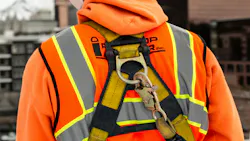
According to federal OSHA 1910 General Industry standards, employers are legally mandated to provide fall protection to employees whenever they are exposed to a fall hazard of 4 ft or greater. In the OSHA 1926 Construction standard, the trigger height requiring fall protection was raised to 6 ft or greater. At those heights, OSHA will deem safety netting, guardrail, and personal fall arrest systems as equally compliant solutions.
Most safety professionals will confirm that not all fall protection systems are created equal. Some (like guardrails) are extremely simple, while others (like horizontal lifelines) can require extensive engineering to install and present a steep learning curve for experienced and inexperienced users alike. The more complicated the system, the more likely misuse and accidents can occur. Equipment misuse and accidental falls are the prevailing conditions that lead to workplace tragedies.
Each fall hazard in a facility or job site must be evaluated to determine the fall protection solution that provides the highest protection factor for the worker. However, ease of use should also be considered. This article will discuss various types of fall protection solutions and describe how effective each solution is at preventing injuries or fatalities.
Hierarchy of fall protection controls
When a fall hazard is identified, the parties responsible must determine which solution is most applicable for the situation. Many industry experts refer to the hierarchy of fall protection controls (see Figure below) for guidance. The hierarchy ranks fall protection solutions from most effective to least effective regarding preventing injury or fatality to the worker.
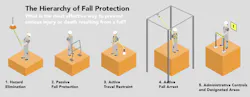
Hazard elimination sits at the top of the hierarchy because removing a fall hazard eliminates the chance of a fall occurring, which obviously prevents an injury from a fall. Moving down the hierarchy increasingly exposes the worker to the risk of falling, thus steadily increasing the chances of injury and, ultimately, fatality.
This is not to say that hazard elimination is the most ideal fall protection solution for every fall hazard because eliminating hazards may be impossible or infeasible in certain environments, especially in construction. Nevertheless, when preventing injuries and fatalities is the ultimate goal of a fall protection program, it is always worth practicing the mental exercise of figuring out how hazard elimination would even be possible, infeasibility aside. Every employer should strive not only to meet minimum OSHA standards but also to find solutions that prioritize keeping workers protected from harm.
Passive fall protection
When hazard elimination is deemed impossible or infeasible for a given hazard, the hierarchy encourages us to use the next most effective method: passive fall protection. Passive fall protection solutions are extremely effective in preventing fall injuries because they require little to no input from the user to provide protection.
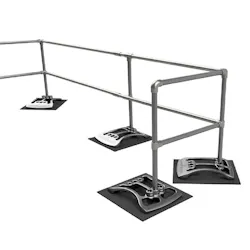
A guardrail is one of the most common examples of passive fall protection. Once a guardrail is installed on a job site, there is no inspection, certification, or training process required for users. As long as workers simply work on the correct side of the guardrail, their fall hazard is virtually eliminated from their work area. Furthermore, guardrails do not even have to be permanently installed to comply with OSHA guardrail specifications. In fact, many job sites prefer to use temporary or portable guardrails (see Photo below) for their ease of mobility around the job site as the project progresses and for their superior protection factor.
Active fall protection
In many areas on a job site, guardrails may be deemed infeasible to use due to space limitations or other valid reasons. When that occurs, active fall protection solutions are next on the hierarchy. Fall restraint systems should always be attempted before using fall arrest systems. However, many job sites are wary about using fall restraint systems because they limit the working area for the tied-off worker, and many companies are unwilling to compromise productivity when other “equally compliant” fall protection solutions are available.
Fall arrest systems are extremely common on job sites, but it is important to remember that the worker will be 100% exposed to the fall hazard while working in a personal fall arrest system (PFAS). While fall arrest equipment is intended to prevent the user from falling all the way to the next lower level, it does not guarantee injury or fatality prevention. In fact, the Center for Construction Research & Training (CPWR) reported that nearly 60% of fall fatalities occurred while the user was wearing fall protection equipment, according to a study conducted in 2021. Equipment misuse can create unforeseen vulnerabilities in fall protection systems, leading to avoidable injuries or fatalities.
Training employees for provided solutions
Fall arrest systems will require the most training because many factors can affect their effectiveness when a fall occurs. Body harnesses are not “one size fits all,” so users must know how to properly adjust their harness to their body. If a harness is too loose, the user can be ejected from the harness during a fall arrest. And if a harness is fit too tightly, it can further restrict blood flow while the user is suspended and awaiting rescue.
Minimum fall clearance requirements must be adhered to when assigning connection devices to users. That is the minimum required distance between the user and the next lower level, and the product’s instruction manual will include this information. For example, 6-ft shock-absorbing lanyards typically require at least 18 ft of fall clearance to guarantee fall arrest can occur. Users working below that height may be at risk of contacting the ground before their fall is fully arrested. If a body in motion contacts the ground before fall arrest is complete, the user will sustain more severe injuries.
Self-retracting lifelines (SRLs) will require less fall clearance, but employers must confirm their workers are always working above the minimum clearance as specified by the manufacturer. Additionally, employers must confirm that minimum fall clearance requirements can be met before assigning certain connection devices to their workers.
No matter the fall protection solution chosen to mitigate specific fall hazards, OSHA requires employers to train workers on how to use their equipment before they can be authorized to work at heights. As stated previously, guardrail solutions will require no training because they do not require user input to be effective in protecting the worker from a fall.
Conclusion
Using the hierarchy of fall protection controls will help employers determine the effectiveness of their current fall protection solutions, relative to other possible solutions. As long as fall protection is provided, that usually means an organization is headed in the right direction. However, we should always strive to make our fall protection programs more robust, more preventive, and more effective at preventing falls in the first place. If we prevent the fall, we are guaranteed to prevent the potential injury.
Fall protection programs often carry a preconceived notion that they must be intricate, sophisticated, or complicated to be effective in protecting workers. However, simple solutions that are used consistently will best protect workers. There’s a popular phrase in the safety industry that says, “The best fall protection system isn’t the most expensive; it’s the one people will use every time they work.” All efforts made to protect workers today can help prevent tragedies tomorrow.
About the Author
 Philip Jacklin
Philip Jacklin
Philip Jacklin is the Continuing Education Program Manager for Diversified Fall Protection. He is an AIA continuing ed provider, QSSP certified, OSHA-30 trained, and has been a partner to the fall protection industry since 2018. Philip has a background in worker advocacy, team leadership, and fostering camaraderie among peers. He enjoys playing music, writing, and spending time in the sunshine with his family in Virginia Beach, Va.