Elevating Safety: Essential Tips to Prevent Falls and OSHA Citations
Key Takeaways
- Reduce time at elevation by planning tasks and preparing tools and materials on the ground to minimize ascents and descents.
- Always inspect equipment like ladders, lifts, and scaffolding before use, checking for stability, damage, and hazards both above and below.
- Use appropriate PPE, including OSHA-compliant work shoes for traction and properly maintained fall protection gear, and inspect PPE regularly for damage.
- Practice proper climbing techniques by maintaining a forward tilt, watching foot placement, and avoiding the 'death grip' to reduce fatigue and fall risk.
- Develop a system for passing tools and materials safely, such as using a bucket and rope, to keep three points of contact and prevent accidents.
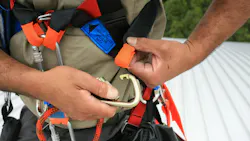
Each year, four of the top 10 OSHA citation categories are elevation-related, and falling from elevation is a major cause of death on the job. The following tips will help you avoid being yet another statistic in the losing fight against gravity.
Don’t be there
“Don’t be there” is arguably the primary rule of safety. Try to reduce the time needed at elevation and the number of ascents/descents. What prefab can you do on the ground? What tools and test equipment can reasonably be anticipated for the job? How can the work be planned, organized, and supplied to reduce time above grade?
If you’re up there and realize you should have brought a reciprocating saw, don’t just go get it. Save a trip or two by mentally walking through the remaining steps to see if you need something else, too.
Understand the elevator
Ladders can slide, lifts can tilt over, and scaffolding can collapse. No means of elevation is inherently safe, but all of them can be rendered acceptably safe if you consistently apply the rules for using them. Given OSHA’s citation stats, there’s a fair chance your employer has not provided adequate training. So actively go after that training.
But not when it comes to ladders, right? You just lean an extension ladder against the wall and walk up it, right? Nope and nope. If the ladder slips due to an incorrect angle or inappropriate feet, the results may be fatal. If the ladder is too far laterally from the work, the results may be fatal. There’s much more to ladder use than leaning and walking.
Scissor lifts, fixed ladders, and scaffolding seem safer, but they have issues too. Know them all, and act accordingly.
Inspect before going up
What can you see from ground level that might be an issue up there? For example, can you identify the fall protection anchor points? Missing guardrail?
Inspect your means of elevating. For example, test the controls on the scissor lift. Look for battery corrosion and evidence of hydraulic leaks. Ensure its outriggers are correctly deployed, and the system is stable. Look up to see if there is clearance to extend the platform close enough to the work; if not, can you move the platform a bit to gain clearance? Look for dangers above, such as an energized busway. Look for dangers below, such as combustibles that could ignite and trap you on the platform. Look for dangers to others. Does this area need to be roped off?
Redo when relocating
It’s sometimes tempting with a scissor lift to just drive from point to point with the platform extended; what can go wrong? Grabbing a ladder from the top and bumping it along the grade to move it over a foot saves time, right? These and other shortcuts are pure gambling. Some scissor lifts are designed for the aforementioned purpose; most are not. For those that are, some rules apply, such as you scoping the driving path first.
If you must move a lift or ladder just a few inches, treat that as an entirely new setup. Much of your “checklist” work is already done, so this doesn’t take as long as it might seem (just address what may have changed). Mainly, you must ensure against sliding (ladder) or tipping (lift). Also, check that there’s no new hazard (e.g., mud from shoes now on a ladder rung) that would present a slipping hazard.
Correctly use the appropriate PPE
A harness and lanyard won’t protect you on the way up; that job falls mainly to your shoes. One of the safety features of a work shoe (or boot) is the superior traction it provides compared to, say, a casual leather shoe. When you’re climbing a ladder, there is a far greater chance you will slip with your foot than with your hand. You reduce that chance dramatically with a pair of serviceable OSHA-compliant (e.g., ASTM F2412) work shoes.
Employer-provided personal protective equipment (PPE) ranges from nets to harnesses. Whatever it happens to be, assume it isn’t suitable until you establish otherwise. Is the net suspended with enough room under it that you won’t get impaled? Is your harness past its “freshness date”? Do not use expired PPE. Visually inspect all PPE and reject ones that show any signs of damage or wear.
Fall protection PPE for construction and maintenance is designed for a quick catch, not a soft catch. For example, there is hardly any give in a fall protection lanyard. When it catches, the user feels the full force. To limit the energy involved, lanyards are limited to 6 ft (or less) with instructions to never climb above the anchor point. If you go 6 ft above the anchor point, that’s a 12-ft fall.
Climb with technique
When climbing a ladder, tilt your body (center of gravity) forward. This reduces the force that must be held by your hands and arms. It also increases your traction on the rung by shifting lateral force (decreases adhesion) into vertical force (increases adhesion). Ideally, you would lay your body flat against the ladder while climbing, but in reality, you can’t quite do that.
If you put an average-sized shoe on a typical ladder rung, about three-fourths of your shoe is supported by nothing but air. To make that shoe stick to the rung instead of sliding off it, raise your heels slightly while climbing a ladder and consciously push down a bit. This may seem counterintuitive, but it is exactly how rock climbers stick to much smaller surface areas. Yes, climbing shoes help with this, but so do OSHA-compliant work shoes.
Always look where you intend to put your foot before you put it there. Yes, rock climbers do this too. Rather than feel for the rung and possibly miss it, watch what you are doing and place your foot precisely. Once the foot is placed, redirect your gaze to where you are going.
Some people climbing ladders use a “death grip” to feel more secure. You can maintain this maximum grip for about 15 sec, after which it will steadily get weaker. A grip similar in firmness to a handshake is sufficient. One problem with the death grip is that it feeds the fear response, which makes you more likely to make a mistake and fall. Just stay calm, watch your foot placement, and keep your body weight as close to the ladder as is practical.
Have a system for tools and materials
If you try to carry material up with you, how can you maintain three points of contact on the ladder? One alternative is to have an assistant throw things up to you. The owner of a service company in Mentor, Ohio, banned this method after he personally lost an eye that way.
You may have noticed roofs being replaced after a hailstorm. Most roofing companies use a conveyor lift to get the materials onto the roof instead of having workers haul them up. It’s faster, there’s less material breakage, and it’s safer. That kind of system is overkill for the typical electrical job done at elevation, but for large or heavy items, you should be thinking sharply in that direction. Power tools and small parts can be passed up and down via the tried-and-true bucket and rope system.
Identify and address unsafe points
Once you’re at elevation, repeat the assessment you did from grade. What dangers can you spot, and how can you protect yourself against them? Note that “be aware of it and work carefully” is a weak protection that is prone to failure. Come up with a solution that will physically prevent your body from falling to grade.
Moving at elevation
As with climbing, look where you are putting your foot before and while putting it there. You could easily step into an opening, onto a loose scaffold board, or into something slippery. You could slip on a loose tool or step right off the edge.
If you’re standing on a ladder, keep your head between the rails. Don’t lean to the side to reach something, no matter how close it seems. Why? Because this will keep the centerline of your body mass roughly in line with the center of the ladder. That alignment is what prevents the infamous, and often deadly, sideways ladder fall.
Inherently doesn’t mean always
Working with electricity is inherently dangerous, yet electricians typically enjoy a long and rewarding career. Working at elevation is inherently dangerous, yet many people do it day after day for decades. In both cases, the positive outcome is a result of consistently working safely. It’s not humanly possible to remember every safety rule all the time. But it is well within your ability to look at each situation for its potential dangers so that you don’t have to rely on memory alone.
About the Author
 Mark Lamendola
Mark Lamendola
Mark is an expert in maintenance management, having racked up an impressive track record during his time working in the field. He also has extensive knowledge of, and practical expertise with, the National Electrical Code (NEC). Through his consulting business, he provides articles and training materials on electrical topics, specializing in making difficult subjects easy to understand and focusing on the practical aspects of electrical work.
Prior to starting his own business, Mark served as the Technical Editor on EC&M for six years, worked three years in nuclear maintenance, six years as a contract project engineer/project manager, three years as a systems engineer, and three years in plant maintenance management.
Mark earned an AAS degree from Rock Valley College, a BSEET from Columbia Pacific University, and an MBA from Lake Erie College. He’s also completed several related certifications over the years and even was formerly licensed as a Master Electrician. He is a Senior Member of the IEEE and past Chairman of the Kansas City Chapters of both the IEEE and the IEEE Computer Society. Mark also served as the program director for, a board member of, and webmaster of, the Midwest Chapter of the 7x24 Exchange. He has also held memberships with the following organizations: NETA, NFPA, International Association of Webmasters, and Institute of Certified Professional Managers.