Protection from Underground Electrical Work Hazards
Key Takeaways
- Always obtain and correctly fill out a confined entry permit before entering underground spaces.
- Use gas detectors, inspect shoring, and ensure proper lighting/ventilation to mitigate hazards like gas leaks and collapses.
- Maintain constant communication with an attendant who monitors your safety and is ready to assist or call for help if needed.
- Never use cabling or raceways for entry or exit; always rely on provided ladders and proper equipment.
- Verify all safety conditions personally; do not rely solely on others' assurances that the space is safe.
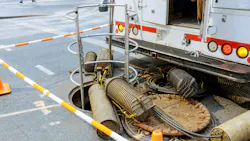
Of all types of work in the construction industry, underground work has the highest rate of injury. Nearly all of the incidents recorded over the past decade were easily preventable.
The first thing to understand is an underground space is a confined entry space. Obtain a confined entry permit and fill it out correctly. If you don’t understand something on the permit, ask the person in charge of the space. If you don’t agree with something on the permit or there’s an unsubstantiated claim (e.g., atmosphere is marked as safe but there’s no gas reading recorded), don’t enter the space until the issue has been resolved.
OSHA provides the employer’s requirements for work in underground electrical installations in 29CFR 1926.965. This fits within the larger scope of confined entry spaces, for which OSHA provides requirements in 29CFR Subpart AA (1926.1201 through 1213). All of these OSHA requirements should be covered in your company’s employee safety program.
Here are some tips that might not be obvious from that safety program or the training your company provides.
- The two main dangers are gas and collapse. In general, you protect yourself from the gases by responding to the readings on a gas detector and you protect yourself from collapse by inspecting the shoring (supported every X feet, etc.) and wearing extraction gear. Make a point of understanding these in detail.
- If the underground space is a vault or manhole, there’s not usually a danger of collapse. But you may still need extraction gear for a number of reasons. For example, you will need it if there isn’t room for a rescuer to climb or crawl in there with you.
- If there’s water in the underground space, insulation damage on energized conductors will likely prove lethal. Address this issue before putting any part of your body into that space.
- Never use cabling or raceway as a climbing means for entering or exiting the underground space. OSHA requires your company to provide a ladder.
- Once you are underground, you are dependent upon your attendant for your safety. And your attendant is dependant upon others. Ensure your attendant has no other duties and knows to remain vigilant outside the confined space. That person’s sole purpose in life while you are underground is to keep tabs on you, extract you if necessary, and call for help as needed.
- Make sure the person in charge of the confined space knows where you are. To do that, simply follow the check-in procedures. Never just enter the space.
- Before entering, peer into the space. Is it lit well enough? If not, address that issue before proceeding. Maybe a portable light is all you need, maybe not.
- Take your gas readings upon entering. Take them again once you progress to the exact work location. Take them periodically, as prompted by the attendant (a good attendant is should keep track of the time while you work). If the readings show a problem, alert the attendant. If the attendant can’t increase ventilation, then exit the space.
- If your mind feels foggy or something else is just off, alert the attendant and exit the space.
- If a coworker seems to suffer from a foggy mind or is just off in someway, tell that coworker to exit. If the coworker refuses to leave, you have a problem. Alert the attendant to report the problem to the person in charge of the confined space.
- If a coworker orders you out of the space, don’t argue. Just exit. A disagreement can safely be settled outside the underground space.
- Part of the attendant’s job is to stay in communication with you. Neither a detailed inquiry nor a detailed response is necessary.
- Don’t forget to check your gas meter. If you drop the meter or in some other way potentially damage it, alert the attendant. If you’re almost done and the readings have always been safe, maybe you can take a few minutes to just finish up. Otherwise, get a replacement meter.
The most important rule about working underground is that you take nothing for granted. Don’t let someone else fill out your confined entry permit, and don’t rely on anyone else’s assurances that “it’s safe down there” even if they were just down there. Verify everything before going in.
About the Author

Mark Lamendola
Mark is an expert in maintenance management, having racked up an impressive track record during his time working in the field. He also has extensive knowledge of, and practical expertise with, the National Electrical Code (NEC). Through his consulting business, he provides articles and training materials on electrical topics, specializing in making difficult subjects easy to understand and focusing on the practical aspects of electrical work.
Prior to starting his own business, Mark served as the Technical Editor on EC&M for six years, worked three years in nuclear maintenance, six years as a contract project engineer/project manager, three years as a systems engineer, and three years in plant maintenance management.
Mark earned an AAS degree from Rock Valley College, a BSEET from Columbia Pacific University, and an MBA from Lake Erie College. He’s also completed several related certifications over the years and even was formerly licensed as a Master Electrician. He is a Senior Member of the IEEE and past Chairman of the Kansas City Chapters of both the IEEE and the IEEE Computer Society. Mark also served as the program director for, a board member of, and webmaster of, the Midwest Chapter of the 7x24 Exchange. He has also held memberships with the following organizations: NETA, NFPA, International Association of Webmasters, and Institute of Certified Professional Managers.