The Northeast Construction Shift: Moving Away from Ladder Use on Jobsites
Key Takeaways
- Ladder-related injuries remain a significant concern, prompting GCs to restrict or eliminate ladder use for many tasks.
- New protocols require subcontractors to justify ladder use through detailed risk assessments and explore safer alternatives whenever possible.
- Safer access solutions such as lifts, scaffolding, and podium-style ladders are gaining favor for their stability and fall prevention benefits.
- Adapting to these changes demands increased planning, coordination, and investment from subcontractors, but enhances overall site safety.
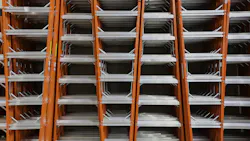
In my role as a construction safety professional supporting projects across the Northeast, I’ve seen a noticeable shift in how general contractors (GCs) approach ladder use on jobsites. Once considered a convenient solution for short-duration tasks, ladders are increasingly restricted, or eliminated altogether, as GCs place greater emphasis on fall prevention and risk mitigation.
Over the years, ladder-related incidents have consistently appeared in injury reports, often tied to tasks that crews assume are low risk. Those assumptions are exactly what many general contractors are now rethinking.
Rather than being driven by preference, this shift reflects real-world experience managing injuries, near misses, and insurance exposure. Ladders remain a leading contributor to serious injuries on construction projects, prompting many GCs to reassess how and when they are permitted.
Why Ladder Use Is Being Reconsidered
Falls from ladders continue to rank among the most frequent and severe jobsite injuries. In my experience, even short-duration tasks, often described as “just a few minutes on a ladder,” have resulted in fractures, head injuries, and long-term impacts for workers. In the Northeast, where projects often involve tight schedules, congested interiors, winter conditions, and work above finished spaces, those risks are amplified.
I’ve seen incidents occur during routine work, not just complex installations, which has led many GCs to question whether ladder convenience is worth the potential consequences.
At the same time, general contractors face increased pressure from insurance carriers, owners, and regulatory agencies to demonstrate proactive fall-prevention strategies, making unrestricted ladder use harder to justify.
New Expectations on Jobsites
On many projects I support, ladder use is no longer assumed to be acceptable by default. Subcontractors are often required to complete detailed, task-specific risk analyses and, in some cases, submit ladder permit applications. These processes typically require documentation showing:
- Why ladder use is necessary
-
Why safer access methods cannot be used
-
Task duration and working height
-
Surface conditions and surrounding hazards
-
Worker training and supervision
The expectations have clearly shifted. If a safer access option is available, subcontractors are expected to use it or clearly explain why they cannot.
As a result, the burden of proof has shifted to the subcontractor, and ladder use is often denied when alternative equipment is feasible.
Safer Alternatives Gaining Traction
To reduce fall risk, general contractors are increasingly favoring more stable access solutions, including:
- Manual push lifts for overhead installations and inspections
-
Baker scaffolding with full guardrail systems for extended work at height
-
Wide-tread step stools or podium-style ladders that provide greater stability and usable platform space
From a safety standpoint, these alternatives directly address the most common causes of ladder falls: overreaching, loss of balance, and improper footing.
“When teams switch from ladders to lifts or scaffold, we see better control of the work area and fewer near misses,” said Mike DeGloria, Operations Manager at JM Electrical in Lynnfield, Mass. “It takes more planning, but the jobsite is safer because of it.”
Challenges for Subcontractors
For subcontractors, particularly those performing electrical, low-voltage, mechanical, and finish work, this shift presents real challenges. Alternative equipment can slow mobilization, increase costs, and complicate work in confined spaces. Tasks once completed quickly may now require additional planning, coordination, and setup time.
However, these expectations are becoming standard practice rather than temporary policy changes. On many projects, adapting to stricter access protocols is now a baseline requirement.
Adapting to the New Reality
Subcontractors who proactively update their safety programs, train crews on alternative access equipment, and budget for safer work methods will be better positioned to succeed. From my perspective, a demonstrated commitment to risk mitigation, not just productivity, has become a differentiator.
This shift isn’t about eliminating ladders entirely. It’s about recognizing when the risk outweighs the convenience and making informed decisions to protect workers.
About the Author
 Kevin Kolhonen
Kevin Kolhonen
Kevin Kolhonen is an experienced safety professional with a demonstrated history of working in the insurance/safety fields with specialization in the energy, construction, and transportation sectors. Currently, he is the health and safety manager at JM Electrical, a specialized electrical contractor in Greater Boston. As safety manager, Kolhonen is responsible for wide-ranging assignments, including the implementation, management, and maintenance of the company’s safety policies, procedures, compliance plans, and improvement initiatives. He also monitors industry regulations, visits construction sites to ensure the safety of the JME team, and establishes communications with field supervisors and field staff among other stakeholders. A graduate of Salem State University, Kolhonen brings significant experience in employee health and safety, loss prevention, and risk management to his role at JME. You can reach Kevin Kolhonen at [email protected] and learn more about JM Electrical at www.jmelectrical.com.