Solving Communication Gaps Across Large Job Sites
Key Highlights
- Assess site layout and communication needs before selecting radios, repeaters, and antennas.
- RETEVIS RT97L configuration illustrates how elevated antennas can help address multi-floor coverage challenges.
- Plan for changing work areas, equipment reuse, regulatory requirements, and project-specific support.
Communication gaps are an operational problem
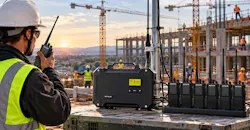
On a large construction site, missed radio messages can slow coordination between supervisors, lifting crews, materials teams, and workers moving across the property. Concrete floors, steel frameworks, heavy equipment, and changing work areas can all complicate coverage. Basements, upper floors, and enclosed structures pose particular challenges.
For electrical contractors and project managers, the solution is rarely as simple as purchasing more handheld radios. Reliable communication starts with understanding the site: where teams work, which conversations are critical, and how the layout will change as construction progresses.
Start with the site, not the equipment catalog
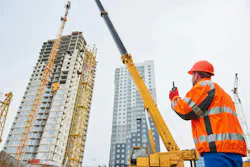
Before choosing a radio system, identify the areas that need coverage and the obstacles between them. A useful assessment maps work zones, building levels, antenna mounting opportunities, power availability, and any existing radio equipment.
Team structure matters just as much. A site with separate lifting, electrical, logistics, and safety crews may need organized communication channels rather than one shared conversation. Contractors should also consider whether the system can move with the project and whether the selected equipment meets applicable local frequency and licensing requirements.
These findings help determine when direct handheld-to-handheld communication is sufficient and when a repeater-based approach deserves consideration. A walk-through or preliminary coverage survey can reveal dead zones that are not obvious from a floor plan. Teams should test communications at the locations where missed messages would have the greatest operational consequences, including lifting areas, stairwells, service rooms, and basement access points. Documenting these findings gives project stakeholders a common basis for equipment selection and later verification.
Extend Coverage with a Planned Repeater System
RETEVIS RT29 handheld radio can support direct communication in demanding work environments. Where building geometry or distance limits direct coverage, a properly configured repeater may help bridge the gaps.
RETEVIS RT97L 25W repeater, in applicable configurations, uses a built-in duplexer for operation with a shared antenna. A suitable high-gain antenna, carefully selected mounting position, and low-loss feeder cable can help the system receive and retransmit signals into areas that handheld radios struggle to reach directly.
Output power alone does not determine results. Antenna elevation, cable loss, surrounding structures, operating frequencies, and site-specific interference all influence performance. Coverage should be evaluated and tested under actual working conditions rather than inferred from a maximum-distance claim.
Project Scenario: Two 28-Story Buildings
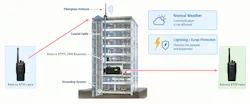
A construction project involving two 28-story buildings illustrates the planning challenge. The communication requirement extended from basement work areas to upper-floor operations, while concrete and steel structures complicated the signal path.
A RETEVIS configuration described for this project combined RT29 handheld radios, an RT97L 25W repeater, a high-gain antenna, and low-loss feeder cable. Locating the antenna at an elevated position was intended to improve vertical coverage. As the construction phases changed, the antenna could be evaluated for relocation to a rooftop or another suitable position without automatically replacing the handheld fleet.
Separate channels could help coordinate construction activities, lifting operations, materials movement, safety, and site management. The lesson is practical: a coverage plan should address the whole system, including placement and future adjustments, not just the radios in workers’ hands.
Coordinate Teams Without Adding Radio Traffic
For projects involving several crews, digital mobile radio (DMR) can provide structured communication through supported talk groups and calling functions. Supervisors may need to reach an individual, a department, or a broader group without occupying every conversation on the site.
Selected RETEVIS digital models also offer features such as emergency alerts, encryption, or lone-worker functions. Availability varies by model and configuration, so project teams should verify the exact capabilities needed instead of assuming every radio supports the same functions. Worker-safety features supplement, rather than replace, established site safety procedures.
Design for Change and Equipment Reuse
Construction coverage requirements evolve. Temporary work areas disappear, crews move to new floors, and equipment may need to serve the next project. Portable repeaters, modular antennas, and reusable supporting components can make a system easier to adapt where site conditions permit.
Compatibility with existing radios and infrastructure should be reviewed early. Reusing suitable equipment may help control costs, but it requires checking frequency plans, operating modes, accessories, and any integration constraints. A practical design balances present-day coverage with the flexibility to relocate, reconfigure, or expand later.
Compliance and Project Support
Professional radio systems must be selected for the market and operating environment. Frequency authorization, permitted transmitter power, equipment certification, and site-specific rules may differ by jurisdiction. Contractors should confirm requirements before deployment.
RETEVIS works with customers to review communication needs, select appropriate equipment, and explore system configurations. Depending on project scope, this may include planning assistance, configuration guidance, and deployment support. The objective is a communication approach aligned with the actual job site, rather than a one-size-fits-all equipment list.
Discuss Your Job-Site Communication Needs
Planning coverage for a high-rise project, a large construction site, or a changing work area? Bring your site layout, coverage challenges, and existing equipment details to the conversation.
Meet RETEVIS at PMRExpo 2026, November 24–26, in Cologne, Germany, Hall 8, Stand A-035. Electrical contractors, facility managers, system integrators, and industrial operators are welcome to discuss project-specific communication requirements.
Not attending the show? Contact RETEVIS to discuss your project requirements.