Data Center Buildout Fuels Revenue Blowout: EC&M’s 2026 Top 50 Electrical Contractors Special Report
Key Takeaways
- Data center projects remained the top market for 91% of firms, significantly impacting revenue growth and business opportunities, especially with AI-driven expansion fueling demand.
- Industry revenues reached over $80 billion in 2025, marking a 35% increase from 2024, with most firms experiencing double-digit growth and some exceeding 50%.
- Supply chain disruptions, material price hikes, and labor shortages challenged contractors, leading to increased use of off-site construction and strategic planning to mitigate delays and costs.
- Community opposition and permitting delays emerged as new risks for data center projects, prompting firms to enhance project vetting and stakeholder engagement.
- Contractors are investing in workforce development, apprenticeship programs, and off-site manufacturing to address labor shortages, with a focus on attracting diverse talent and increasing productivity through technology and AI.

Sponsored by Champion Fiberglass

Beating back persistent labor challenges, project logistics headwinds, and a pervasive climate of flux on multiple fronts, leading electrical contractors leveraged a growing data center and power infrastructure buildout to post stellar revenue gains in 2025.
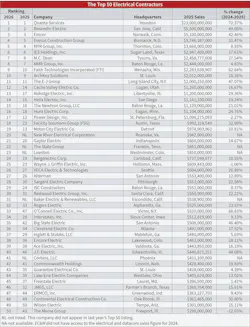
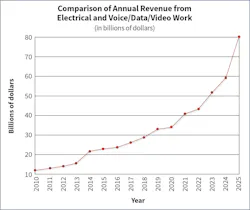
A collection of electrical contractors polled in 2026 by EC&M reported combined 2025 revenues of $80.417 billion, placing them in the exclusive group that forms our Top 50 Electrical Contractors (see Rankings Table). That combined revenue tally comes in a whopping 35% higher than 2024 revenues for the 2025 Top 50, marking an unprecedented year-over-year gain for the annually top-ranked firms (see Historical Trends Chart). Only six of the 43 firms that were in last year’s Top 50 list reported revenue declines this year; revenue increases for most were in double digits — with some handily topping 50%.
Continued growth in data center construction work heavily reliant on electrical professionals played to the industry’s strengths, dropping business into the laps of contractors with data center know-how and sending many of the rest scrambling to get a piece of the action.
All together now: data centers
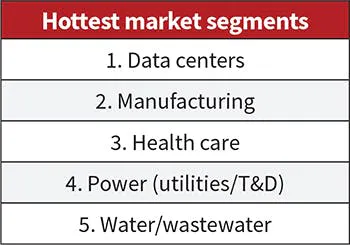
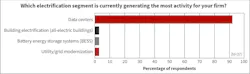
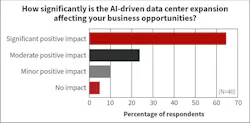
Data centers were on the list of the three hottest 2025 markets (Fig. 1 on page 34) for 91% of responding firms — five percentage points higher than last year. That market has been the top vote-getter for years, but the share listing it has steadily grown. Data centers also overwhelmingly received the most mentions as the component of the broad electrification trend generating the most activity for Top 50 respondents (Fig. 2), with 92% saying it’s the primary driver. Further evidence of data centers’ impact: 63% say “AI-driven (hyperscale) data center expansion” is exerting a significant positive impact on business opportunities (Fig. 3).
Once again, no other market came anywhere near data centers in frequency of hot market mentions. But this year, power & utilities made a stronger showing, reflecting growth in a budding power transmission & distribution buildout that has strong ties to growing data center construction. That market was on 28% of firms’ top three markets list, which is double last year’s figure. Meanwhile, manufacturing, health care, renewables, and water/wastewater were highly ranked again.
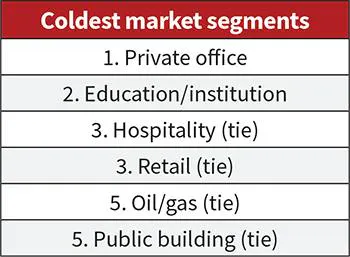
Contractors may have enjoyed firmer markets across the board in 2025. Those making more firms’ “slow” list (Fig. 4) included private office, education/institution, retail, hospitality, and oil and gas. That resembles last year’s ranking, but slow market mentions were somewhat less concentrated. Private office and education/institution drew more mentions while hospitality, retail and oil/gas got fewer.
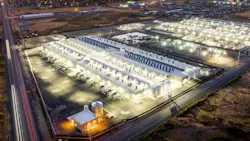
Interstates, Inc. (No. 34), Sioux Center, Iowa, has been a fixture in serving the broad industrial sector, but some continued softness in pockets there has led it to engage more deeply in other emerging markets.
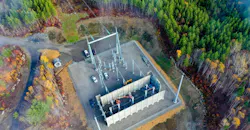
“From a construction perspective, many of these (industrial) markets have seen slower growth in the last couple years,” says Chief Financial Officer Joel Van Egdom. “The food and beverage market has slowed the past year or two but is showing signs of growth. Meanwhile, data center opportunities continue to grow significantly, and we saw growth in our manufactured solutions offerings.”
Data centers, advanced manufacturing, and high-power infrastructure have been key markets for Faith Technologies Incorporated (FTI), coming in at No. 9, Menasha, Wis. Executive Vice President Wade Leipold says that sharp focus easily sustained the firm in 2025.

“Demand for reliable power infrastructure continues to grow, driven by AI, cloud computing, electrification, advanced manufacturing, and grid modernization,” he says. “Our customers are investing in larger, more sophisticated facilities that require the type of engineering, planning, and execution capabilities FTI offers.”
Such markets are expected to sustain the growth trajectory at The E-J Group (No. 11), Long Island City, N.Y. The company’s revenues grew by 47%, fed by technology-fueled markets but also bolstered by more traditional sectors.

“Data centers continue to be a major driver of growth, and mission-critical facilities remain strong,” says CEO Anthony Mann. “Beyond that, we’re seeing growth in power generation, transmission and distribution, transportation, renewable energy, and health care.”
It doesn’t get old
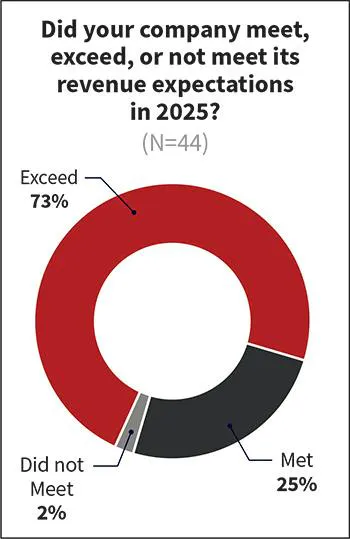
Several years of unrelenting demand pushing planned data center projects through to construction, coupled with overall strong and consistent demand in other sectors, again translated to upside revenue surprises for many contractors. Like last year — when there was a 17-point surge from the prior year — nearly three-quarters say company revenues exceeded expectations in the prior year (Fig. 5).
Michael Parkes, CEO of O’Connell Electric Company, Inc. (No. 33), Victor, N.Y., whose revenues surged 69%, says the company was inundated with work, forcing the company to make choices and be more strategic in taking on new business.
“A lot of engineering and procurement activity in the utility project space is shifting to the construction phase,” says Parkes, adding that more revenue began flowing from data center projects.
Revenues came in stronger than expected at Gaylor Electric (No. 21), Indianapolis, but receipts “could have been larger if we had had sufficient supplies of materials,” says Jim Crews, president.
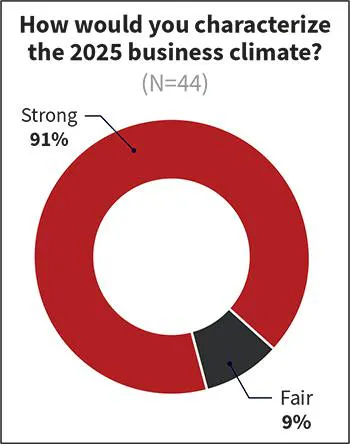
Difficulty securing materials was one of several challenges contractors faced in 2025, none of which, however, seemed to dull overall assessments of the year past. Solid revenues, the broad impact of data center construction, and the growing promise of sustained growth led nearly all firms to rate the 2026 business climate as “strong” (Fig. 6), up a couple of ticks from last year. Strong assessments by respondents have risen steadily since 2022. But supply chain issues, project delays, design glitches, and the ongoing problem of labor availability tested the nerves and creativity of electrical contractors.
A material problem
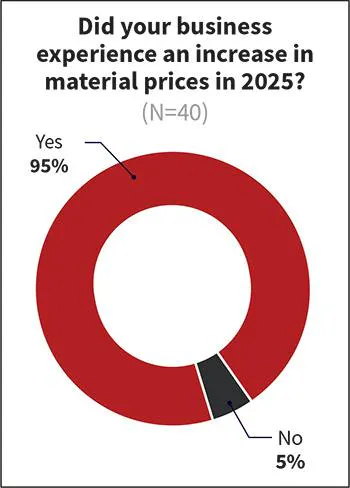
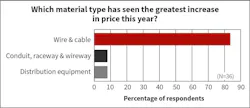
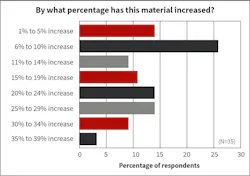
Nearly every firm said it faced increases in material prices (Fig. 7). Driven higher by a combination of surging demand, tariffs, and changing supply chains, prices continued to rise on many essential construction products. Project delays, cancellations, and design changes ensued in some cases, sending ripples of disruption through businesses. The electrical product experiencing the biggest price increase for most firms was “wire and cable” (Fig. 8). Half of respondents said the single material seeing the greatest increase for them rose 15% to 39% (Fig. 9).
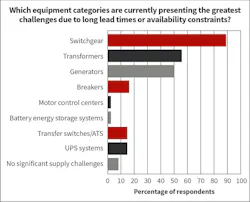
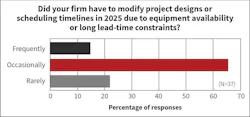
Availability continued to be a problem with many key electrical products contractors need. Respondents overwhelmingly put three products — switchgear, transformers, and generators — on their list of equipment categories with especially long lead times or other availability constraints (Fig. 10). For some, there were consequences; 65% of respondents say they at least occasionally had to deal with modified project designs or scheduling timelines (Fig. 11).
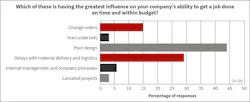
Increasingly compressed project timelines are a growing reality for contractors, and supply chain and design flaw issues top the list of culprits. Nearly half singled out poor design as the variable most impacting on-time/on-budget completion (Fig. 12) — up six points. Material delivery issues were cited by 29% and change-orders by 15%.
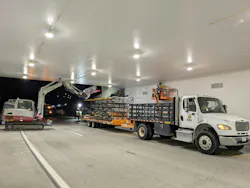
Some projects Sargent Electric Company (No. 28), Pittsburgh, was engaged in had timelines adjusted due to product lead time issues, “but we’ve worked our schedules around it,” says CEO Rob Smith. The industry broadly, he suspects, is now “largely adapting to the realities of the supply chain and reconciling lead times and costs.”
Medium-voltage cables have been a particular problem of late, he adds, and concerns about aluminum supply related to the Iran conflict are joining copper as a construction commodity worry.
Planning is the key to dealing with supply chain issues, which have slowly begun to moderate, says Leipold. “Rather than reacting after projects are underway, FTI is doing our best to plan earlier, (working) with customers and suppliers during pre-construction to identify long lead times, evaluate alternative products when appropriate and make procurement decisions sooner.”
Problems, however, are likely to persist as “trade policies continue to create uncertainty around pricing.”
Policy intrusion
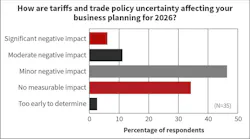
But tariffs and trade policy, generally, do remain an open question and could exert new and unforeseen pressures on the construction industry broadly. But having navigated issues so far, electrical contractors may be checking that worry off to some extent. More than three-quarters of respondents say tariffs and trade policy uncertainty (Fig. 13) had only a minor negative impact or no measurable impact on 2026 business planning.
“Tariffs are temporarily out of the picture” as a big concern, “but we still see supply chain issues,” says Gaylor’s Crews. Long-term tariffs, however, could help beneficially restructure the supply chain and bring more manufacturing of construction products to the U.S., he says. That would be a help now as data center construction ramps up demand, he says, but “near-shoring or re-shoring takes time.”
Another headache that became more pronounced for electrical contractors (in 2025 and into 2026 especially) was growing backlash against data center construction. Across the country, local opposition to data centers spread as worries about impacts on energy consumption and the environment grew. Moratoriums sprouted in some jurisdictions, putting some projects in limbo, while others faced potential delays.

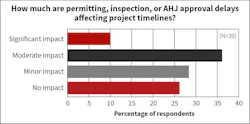
Heavily invested in the data center buildout, some electrical contractors faced complications along with their construction partners. The data center pushback, along with perhaps other “permitting, inspection, or authorities having jurisdiction approval delays,” such as with battery energy storage systems projects and possibly nuclear projects as they surface, might be an emerging concern. The survey found three-quarters of respondents feeling an impact from such scrutiny, with nearly half saying it was significant or moderate (Fig. 14).
A stronger push into the data center market by Hunt Electric Corp. (No. 16), Eagan, Minn., resulted in a big project win that’s moving ahead, but also in others now facing possible delays due to community opposition. Aware of that rising potential risk in that market, CEO John Axelson says the company will be asking more questions about project viability. “During early-on estimating and pre-construction, part of the vetting will be ‘do they have the permitting done and a site they can build on?’”
Laboring with a problem
The other pressing question contractors will be asking — and were asking intently in 2025 — is whether they have adequate labor. The industry’s long-simmering labor shortage got more acute in 2025 as data center construction exploded, stalling projects and leaving many contractors wanting as that sector’s growth siphoned off available workers for other projects.
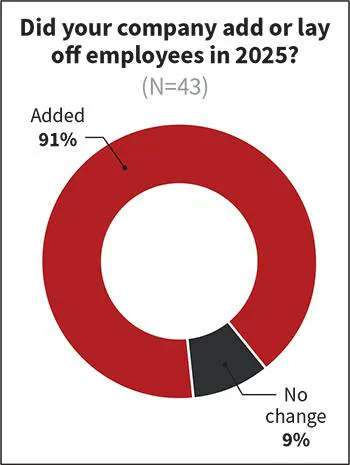
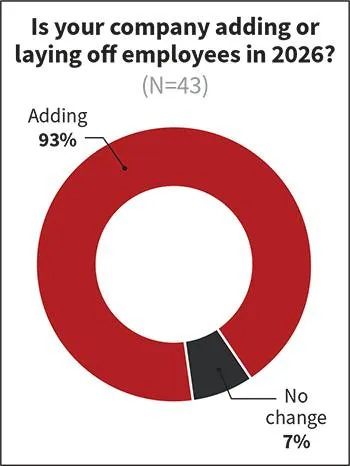
Indeed, data centers may be putting contractors’ labor woes into overdrive. In fact, almost every company surveyed said they added to their workforce last year and expect to this year (Fig. 15 and Fig. 16), at levels slightly higher than in last year’s survey.
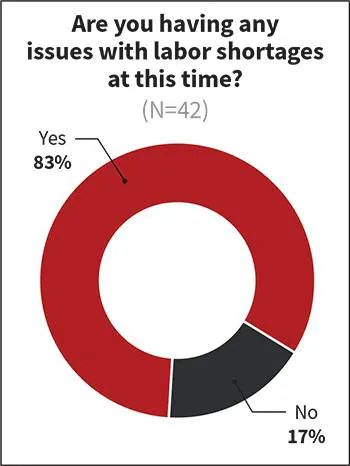
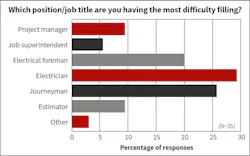
Reported labor shortages (Fig. 17) ticked up also, with 83% saying that was an issue (nine points higher than last year). The biggest need (Fig. 18): electricians, which is a consistent answer going back several surveys.
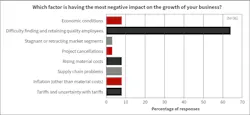
Once again, from a list of high-impact factors that could negatively affect overall business growth (Fig. 19), difficulty finding and retaining quality employees was far and away the top choice — seven points higher than in last year’s survey.
Sargent, Smith says, is keenly focused on labor as a variable that can make or break a project, especially those in challenging markets.
“It’s a tight labor market, and that’s part of the decision process we look at on which jobs to pursue,” he says. “Can we get the people, predict their productivity, and what’s the impact of where the job is? The sum of all those things drives our view on whether a project is a go or no go and how much we’re willing to commit to do a job in a place that may be tough to staff.”
Data center growth has crystallized the industry’s labor challenge, Van Egdom says, one that “will continue to be a challenge into the future.”
A war for talent continues to build in areas thick with both data centers and megaprojects, he adds, ratcheting up long-standing concerns about the looming exit of experienced skilled tradespeople as they age out.
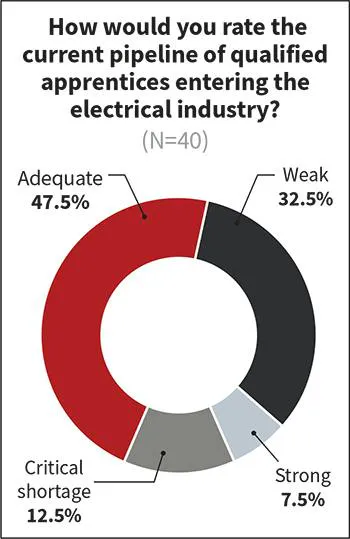
Part of solving the labor problem will involve bringing younger people into the industry, especially into electrician slots via apprenticeship programs. Efforts are starting to bear fruit as program funding expands, but worries persist about the number and quality of entrants and their ability to stay the course. Contractors are of a mixed mind about the state of the apprentice pipeline (Fig. 20); half say it’s strong or adequate, slightly fewer say it’s not good.
“I think the quality is there, with more coming into programs who have some mechanical or farming background with repeatable skills, but also those who don’t have much experience working with their hands,” says O’Connell Electric’s Parkes. “We need more people at this point; I don’t care who they are.”
A barrier to getting more apprentices onto job sites and learning/contributing, he notes, is union limitations on ratios of journeymen to apprentices.
“That’s hampering our ability to bring more apprentices in, leaving more of them sitting at home,” he says.
The E-J Group’s Mann says the apprentice pipeline is improving, but the core challenge is “attracting and developing the next generation, which remains a long-term priority.”
Selling industry jobs, whether in the field or the office, to young people, career changers, minorities, women, and other non-traditional groups is part of the answer, he says. Mann is getting personally involved in that effort, serving in a leadership role on two non-profits working to attract women and high school students into construction careers.
Off-site insight
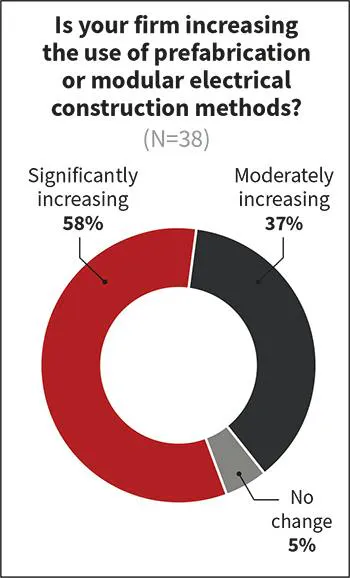
Another approach contractors are taking to the labor challenge is off-site construction. More are turning to pre-fabrication and modular electrical construction operations (Fig. 21) to turn out installation-ready assemblies that can be shipped to job sites. A tactic that can cut down on the need for high-priced labor and make field operations more efficient, its use appears to be widespread; nearly all respondents say it’s increasing — nearly 60% noting a significant shift.
Interstates continues to move more standardized electrical and prefabricated products assembly work off site, building up a dedicated workforce to support a growing element of its business.
“We’re continuing to invest in growing our manufacturing, including prefab, for our projects and providing manufactured solutions for direct sale to clients,” Van Egdom says.
At FTI, the tactic is evolving as the value of off-site construction becomes more apparent. Its operations, Leipold says, are taking on the character of industrialized manufacturing, “taking that next step by integrating manufacturing processes and procedures.” The approach improves quality and safety while keeping projects on schedule, “advantages incredibly valuable in markets like data centers, where speed, consistency and reliability are important.”
Productivity, generally, is an area of growing concern for contractors. The labor shortage is a primary driver, pushing firms to adopt technologies and processes to make workers and operations more efficient.
AI interest matures
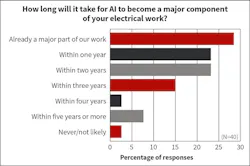
Artificial intelligence is drawing contractor interest as a tool to achieve that goal, but many are taking it slow — perhaps wary of placing too much confidence now into a powerful but still-evolving technology. There’s evidence some contractors may have stepped back a bit from using AI for electrical work. This year, 28% say AI is already a major part of their work (Fig. 22), 14 points lower than last year. Most now say adoption is one to three years off.
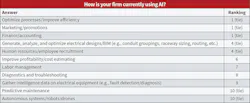
Still, like last year, half of respondents say they’re now using AI to some degree for electrical work (Fig. 23). Likewise, equally common applications are for human resources/recruitment, process optimization, marketing, and cost/profit estimating.

Hunt Electric, Axelson says, is looking to 2027 as the year AI makes a definitive mark on the company’s operations. More training is needed on it, and the company’s software team is researching ways to utilize it more fully, but so far “it has helped people become more efficient, spending more time on what they (critically) need to do every day.”
O’Connell Electric has tasked a committee to study AI integration, consistent with what Parkes says is the firm’s interest in “being on the leading edge but proceeding with caution.”
Early indications are it could relieve staff of monotonous work and repeatable tasks, he says, but “human interaction and quality control on AI is extremely important.” Many contracts already have clauses addressing its application, he adds, so it will be important to “develop some lines to operate between” with AI.

The E-J Group is boring deeper into AI, turning to outside help in finding and accelerating adoption of possible applications. Mann says a new strategic partnership with Augmenta, a specialist in AI-enhanced electrical raceway modeling, will aid engineering, prefab, and project delivery for his company.
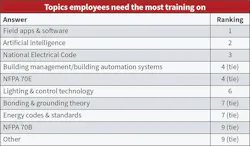
More study of AI and more experience working with it will be critical — and likely an important component of the broad training function at many electrical contractor operations. From a list of about a dozen training areas possibly requiring more attention and support, AI was second in mentions, trailing only field apps/software (Fig. 24).
Seeking a productivity boost
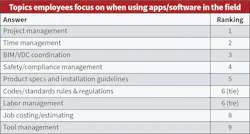
Electrical contractor use of information technology for field operations has expanded, and integration of AI into field apps and software is likely to make them even more powerful productivity-enhancing tools. Their value and utilization are already extensive, contractors say, but project and time management along with safety compliance and building information modeling are primary uses (Fig. 25).
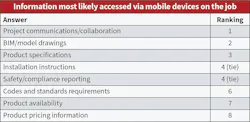
Mobile device usage on the job for contractor employees is a fully mature technology application, but its importance grows as the ability to access detailed real-time project information, likely enhanced by AI as it develops, expands. Contractors say employees are relying on mobile devices for a range of vital information and data, chiefly high-level design, safety, and project management insight (Fig. 26).
Job-site technology is well entrenched, but there’s now a new horizon with software and AI, as well as drones and 3-D cameras, which AI could enhance, Parkes says.
“There’s more change on the software side, and there’s more in process with AI integration,” he says. “And a lot of programs are getting easier to adapt to the field versus five-plus years ago.”
Much has changed even in that span in the electrical contracting world, and the pace of change may be gathering steam. AI is a big part of that story as contractors make their way through 2026 and beyond, but so too are the nature of projects, sources of funding to sustain infrastructure and construction growth, rising costs and availability of inputs impacting profitability, and the pace of continued technology integration.
Banking on infrastructure
Two overarching trends stand to impact electrical contractors: mass electrification and fortifying/hardening power generation, transmission, and distribution. On both scores, there are already signs of a benefit flowing to contractors.
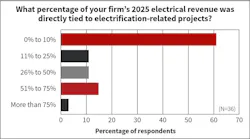
Most polled say they’re seeing a modest, but not insignificant contribution to revenues from electrification projects (Fig. 27) — at most 10%. But a third say they’re seeing more, with 14% saying they’re claiming a 50% to 75% share.
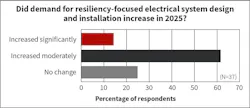
Demand for resiliency-focused projects increased for most contractors in 2025 (Fig. 28), with most terming the increase “moderate.”
Given the size and scale of the need for each, funding will be critical to deployment. Two key expected sources of that funding were the Infrastructure Investment and Jobs Act (IIJA) and the Inflation Reduction Act (IRA).
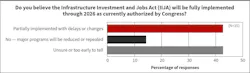
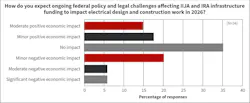
Both are now in some state of legal/legislative limbo, and Top 50 respondents don’t seem to be banking on their survival. Nearly half see the IIJA ultimately changed or scaled back, while the same share say its fate can’t be known now (Fig. 29). Should changes come to pass for both, a third see them rendering a negative impact on 2026 operations. More, however, see either no impact or a net positive impact (Fig. 30).
2026 and beyond stirs excitement
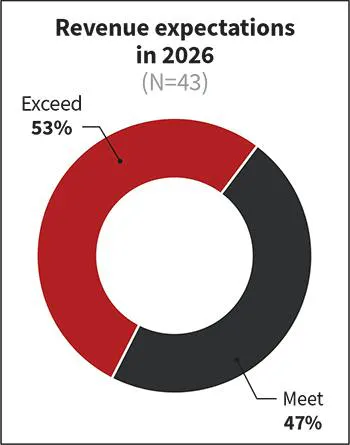
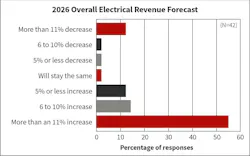
What’s almost certain to impact 2026 performance is what supercharged it in 2025: data centers and power markets. And as of the first quarter, many respondents, though certainly not all, were quite bullish. Half expect revenues to exceed expectations this year (Fig. 31), up 16 points from the last survey, but half say they’ll come in as expected. Half also see revenue growth topping 11%, up 20 points (Fig. 32).
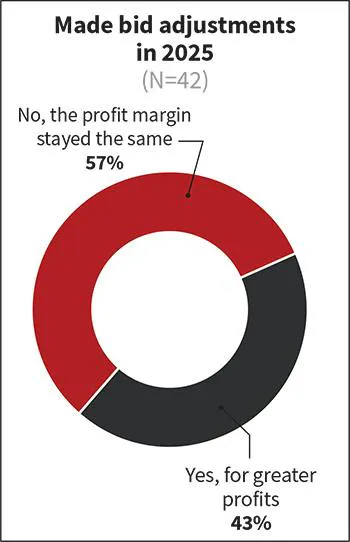
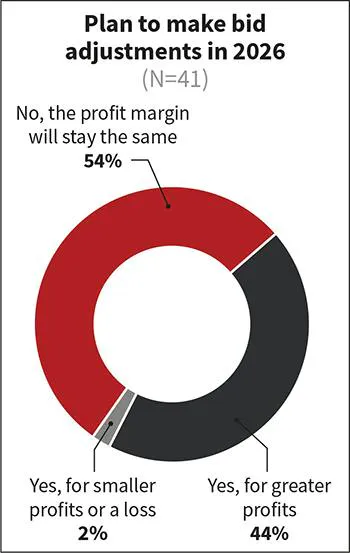
The profit outlook is also solid. Benefitting from surging demand, yet also buffeted by rising costs, Top 50 contractors faced a more rewarding but potentially complex bidding picture in 2025. And that may be the case again this year. Last year, 43% said they generally adjusted bids for greater profit (Fig. 33), up 17 points. Looking to this year, 44% said they’d take the same approach (Fig. 34), up 14 points.
“This will be a stronger year for us than 2025,” says Crews, noting that projects delayed last year will start in the second half. “But this year will also be strong in terms of awards, with a lot of data center work coming.”
Crews expects a long runway for solid revenue gains for Gaylor, projecting a bullish market into 2028 based on how project owners and general contractors are “recognizing that to get things built they have to get ahead of the curve.”
Hunt Electric is counting on longer term revenue boosts from mission-critical project work supplementing health care and renewables projects, but 2026 revenues could be softened by project delays.
“A total of $800 million of data center work has been pushed back, so the start time change changed our revenue projections,” Axelson says. “Peaking of revenues for us has gotten pushed out to 2027 or 2028.”
Sargent Electric is seeing some possible softness in revenues this year as looming questions about capital spending and input costs shift some timelines.
“Overall, we’re not seeing cancellations, but more jobs flipped to the right — now starting maybe in November rather than May,” he says. “More could be moving to 2027, which could be a strong year.”
Widening the lens, Smith sees nothing but growth.
“It’s a healthy industry for some time as megatrends around electrification move through,” he says. “Our project scope is now deep into the 2030s.”
About the Author
Tom Zind
Freelance Writer
Zind is a freelance writer based in Lee’s Summit, Mo. He can be reached at [email protected].