As usual, never consider the following commentary associated with these photos as a formal interpretation of the National Electrical Code (NEC). Without criticizing anyone or any product, the following scenarios present us with serious safety questions.
All references are based on the 2005 NEC.
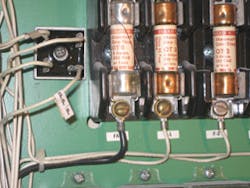
A HAIRY OVERCURRENT PROTECTION SITUATION
Billie Garner, an electrician at Clark College in Vancouver, Wash., found this ridiculous arrangement while investigating an overhead light outage in an elevator. His initial system check revealed the breaker had not tripped, and there was no power present at the light fixture. Further investigation revealed there was power to the car light toggle disconnect switch. However, after he removed the switch cover, the power was gone. When he first checked the fuses, he noticed a slight spark at the base of one unit. This is where a temporary fusing had taken place, which closed the circuit. Upon further inspection, he noticed that someone had installed a hair-like strand of wire between two terminals on the failed fuse (see fuse on left).
Whoever bypassed the overcurrent protection device created a violation of 620.61, which states that overcurrent protection shall be provided in accordance with 620.61(A) through 620.61(D). More specifically, 620.61(A) states, “Operating devices and control and signaling circuits shall be protected against overcurrent in accordance with the requirements of 725.23 and 725.24. Class 2 power-limited circuits shall be protected against overcurrent in accordance with the requirements of Chapter 9, Notes to Tables 11(A) and 11(B).”
HOMEMADE FUSES CREATE RECIPE FOR DISASTER
Derek Thomas, an eight-year journeyman electrician, ran across this installation in a mechanical loft of a new church while working for Classic Electric and Design in Plymouth Meeting, Pa. “The disconnect was feeding heating elements in air handlers,” said Thomas.
How did they get there? “Over a long Thanksgiving weekend the temperature dropped, and one of the subcontractors was screaming for heat. The HVAC contractor came in when we were not there and improvised to get the units running,” said Thomas.
The person who installed these so-called “thinwall fuses” obviously had no regard for human life or property. An overcurrent condition on this system would most likely lead to a horrible ending.
Article 240, Part VI outlines the requirements for a safe installation of cartridge fuses and fuseholders. General marking rules for fuses can be found in 240.60(C).
Found a Code Violation? E-mail your photos to Joe Tedesco at [email protected].
About the Author
Joe Tedesco
Tedesco served the industry in many roles during his career. He was a director, senior electrical code instructor for National Technology Transfer, Inc. and American Trainco, Inc.. He was also a codes, standards and seminar specialist for the International Association of Electrical Inspectors and an electrical field service specialist for the National Fire Protection Association in Quincy, Mass. He ran his own business as an NEC consultant and is a Massachusetts licensed master electrician and journeyman electrician and certified electrical inspector (one and two family 2A; General 2B, and Plan Review, 2C). Tedesco also wrote articles for CEE News and EC&M (Code Violations Illustrated and What's Wrong Here?) for more than 15 years and helped launched the Moving Violations video series.