What’s Wrong Here? Hint: PVC Problems

How well do you know the Code? Think you can spot violations the original installer either ignored or couldn’t identify? Here’s your chance to moonlight as an electrical inspector and second-guess someone else’s work from the safety of your living room or office. Can you identify the specific Code violation(s) in this photo? Note: Submitted comments must include specific references from the 2020 NEC.
Hint: PVC problems

March Winners
A big thanks to Mike Wellman, an employee with Perfection Group in Cincinnati, for sharing this photo with us. In his words, “This picture was taken at an old church that we are installing a VRF system at in Indianapolis. These wires were feeding a circuit in a basement classroom. We discovered them while pulling communication wires for our building automation system.”
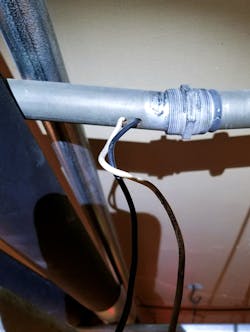
Our winners this month were Lee Summers, a project manager for C Mechanical Services in Lancaster, Pa.; Al Gensitskiy, a reader from Hillsboro, Ore.; and Oscar Muñiz, an apprentice with IBEW Local 332 in San Jose, Calif. They knew running wires of AC circuits through individual openings of ferrous metal enclosures in this manner violates Sec. 300.20(B). They also knew that loose or missing EMT couplings can defeat any grounding or bonding required by Art. 250, while also violating Sec. 358.42. Running individual conductors without being installed as part of a Chapter 3 wiring method violates the requirements of Sec. 300.3(A). Running wires through holes drilled in EMT with no protection from sharp metal edges could result in damaged conductor insulation and, more importantly, arcing, sparking, and possibly a fire. A better option for this installer would have been to install a box near this coupling and extend a cable from the box.
‘Tell Them What They’ve Won...’
Using the 2020 NEC, correctly identify the Code violation(s) in this month’s photo — in 200 words or less — and you could win an Arlington Industries FLBT4400SS countertop box kit, which includes a stainless steel trap door cover and a 20A decorator-style, tamper-resistant receptacle. E-mail your response, including your name and mailing address, to [email protected], and Russ will select three winners (excluding manufacturers and prior winners) at random from the correct submissions. Note that submissions without an address will not be eligible to win.
About the Author
 Russ LeBlanc
Russ LeBlanc
Owner
Russ started in the electrical trade as an apprentice in 1985. He worked his way up to become a Journeyman Electrician and then eventually became a Master Electrician and Licensed Construction Supervisor. In 1999 Russ become an Electrical Instructor for The Peterson School of Engineering in Massachusetts where he developed his passion for teaching, and quickly became Department Head of Electrical Instruction. Russ has taught thousands of apprentices, electricians, engineers, inspectors, and other electrical professionals during his career as an instructor. He continues to provide electrical professionals with Electrical Code seminars, Arc-Flash Awareness training seminars and educational material through his LeBlanc Consulting Services in North Reading, MA whose specialty is educating electricians. He has been an active member of the NFPA Electrical Section and has authored hundreds of National Electrical Code proposals and comments which have become Code rules to improve the safety for the electrical industry. Russ is also an IAEI certified Electrical Inspector.
Please visit www.russleblanc.net for more information.