Stop Inheriting Other Trades' Problems
Key Takeaways
- Early trade integration through advanced technology improves project scheduling, cost estimation, and on-site efficiency.
- Automation frees electrical contractors to focus on high-value project management, innovation, and client value addition.
- Moving away from siloed workflows fosters a collaborative environment, minimizing costly rework and schedule delays.
- Adopting these solutions positions ECs as strategic partners, capable of handling more complex, high-margin projects with greater confidence.

When electrical contractors (ECs) start most projects, they’re already behind schedule. Their work is, by nature, one of the final pieces in the building puzzle. Electrical work is expected to fit perfectly around the complex structural, mechanical, and plumbing systems already in place. As a result, ECs inherit the cumulative friction of every design misstep, spatial conflict, and scheduling error that occurred upstream. Poor project coordination — the root cause of this last-minute friction — is to blame, and it has major consequences on every EC’s bottom line.
According to the general contractors (GCs) that employ ECs, successful trade coordination is critical to success. In fact, research shows it’s what enables 71% of projects to finish on time and 76% to be completed within budget. Yet, the reality is that one-third of GCs face on-site quality challenges from poor coordination, which inevitably cascades into schedule delays, costly rework, uncomfortable conversations, and significant profit erosion across the trades. This friction is one of the industry’s greatest choke points, leading to losses estimated at more than $17 billion annually.
For the EC, poor coordination translates into a labor and material disaster. An unexpected change in mechanical ductwork or a relocated plumbing pipe can force ECs to rework their entire electrical routing, all while the clock and the labor budget run out. This cycle accelerates and is amplified on the large-scale, mission-critical projects that often need to accommodate frequent design changes and demand zero margin for error.
The path to regaining control lies in reimagining pre-construction coordination. By embracing technology that moves beyond single-trade mindsets, electrical contractors can have their voices heard earlier in the process, resulting in a collaborative pre-construction design process that enables a clash-free path from the start. This approach gives ECs unprecedented control over the process from prefabrication to the grand opening.
The fragmentation trap
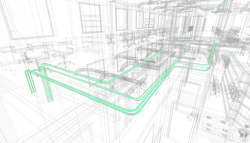
The fundamental challenge here is that most construction projects begin in fragmented silos. Trades work in isolation, pass their models along, and hope the final assembly works — this is how it’s always been done. This siloed approach immediately forces subcontractors into a zero-sum game, leading to trades constantly fighting for space within a building.
Computer-aided design (CAD) and building information modeling (BIM) have improved the process. Electrical teams have come to appreciate these as ways to better manage project complexity, but, while helpful, their impact has been somewhat limited. BIM, for example, has been invaluable in aggregating and accounting for all relevant information/data in a construction process. It can account for a massive amount of project data, and can flag when two systems are going to occupy the same space. It is not, however, an active problem solver, leaving ECs to manually resolve conflicts — a process that can take weeks, both in front of a computer and on site.
When a potential conflict is flagged, ECs oftentimes wait for notoriously contentious multi-trade coordination meetings, then manually go back into the models and spend weeks reconsidering new raceway design options, and finally re-coordinate with the GC and other trades. This clunky process is a massive friction point, costing valuable pre-construction time. As a result, accurate project scheduling is nearly impossible, and teams are forced to spend excessive time at their computer rather than installing conduit on site. It’s time to find a better way.
Designing the way out of conflict and into predictability
The solution is a fundamental shift in philosophy that moves construction design closer to the automated, rule-based efficiency found in advanced manufacturing. This can be achieved through the introduction of spatial AI in the design process.
Instead of using AI to document a single design idea, ECs are now empowered to use technology advancements to become an active hand in problem-solving. These new solutions can feed all of the important context of a project: the relevant specifications and building codes, the spatial constraints and preferences of the site model, and the fabrication requirements — from conduit spacing and bend angles to support preferences and rack sizing. Then, they process countless design possibilities and rapidly generate a set of optimal design alternatives. Without manual coordination, this technology incorporates the key considerations for the design of the entire building (electrical, mechanical, structural, and plumbing) simultaneously.
The output is a constructible, code-compliant design that is not only clash-detected but also clash-free from the start. For the EC, this is a transformational difference. With this technology, the project handoff is not a suggestion that requires weeks of manual rework; it is an executable roadmap.
Impacts of building a predictable project
A clash-free design delivers immediate, tangible benefits to the EC’s bottom line and operational capabilities, including:
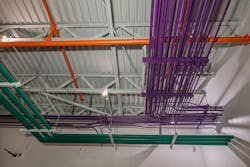
- Improved time-to-execution: By eliminating the multi-week coordination gridlock, ECs can move directly to detailing and prefabrication. The design is a final, constructible plan that reduces project volatility.
- Accurate sub-trade pricing: An AI-optimized design accounts for all materials with precision, eliminating the costly contingency that must be built into estimates to account for field-level design changes. This predictable cost structure stabilizes profit margins.
- Maximized off-site prefabrication: When the correct electrical pathway is guaranteed, ECs can confidently maximize off-site fabrication of assemblies and racks. This eliminates pre-construction design risks by transforming high-cost, high-risk field labor into controlled, high-efficiency shop work that boosts profitability, safety, and quality.
- Scalability for high-margin services: With AI automating low-level, high-friction work, design teams gain a tremendous productivity boost. This enables EC firms to confidently take on more complex projects and capture more revenue per project, evolving from a subcontractor to a core design partner.
The connected builder: Liberated to innovate and create value
Coordination issues are the clearest signal of an inefficient process. By unifying the trades earlier in the pre-construction process, AI-powered generative design stops bottlenecks before they happen, transforming the role of the EC.
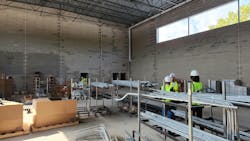
This technology is not intended to replace electrical professionals. With automation handling the massive, months-long effort of design coordination and conflict resolution, ECs are freed to take on higher-value, project-management-focused roles. These leaders can then orchestrate the job from a technical standpoint and manage the critical human elements — the reasoning, negotiation, and on-site nuances. This transition grants ECs the time to focus on adding additional value for their clients.
AI-powered generative design will allow the construction industry to move away from an outdated system of constant conflict resolution and toward a collaborative model with integrated project delivery. As a result, the EC can focus its expertise on technical mastery and high-value installation, liberated to innovate and help create structures that are built on time, under-budget, and more sustainably by default.
About the Author
 Aaron Szymanski
 Aaron Szymanski
Aaron Szymanski is a co-founder and head of product at Augmenta. He leads Augmenta’s product definition and design efforts - bridging the gap between computational science, artificial intelligence, and the needs of users and organizations within the AEC industry.
Before Augmenta, Szymanski founded and helmed real/ideal, a strategic foresight and product strategy firm. There he led engagements with clients such as Shopify and Facebook to identify emergent market opportunities and design products for new markets and services.
Previously, Szymanski has worked as an industrial designer at Blackberry designing next generation phones and tablets. He then moved to Xtreme Labs (which became Pivotal Labs through acquisition by Pivotal) where he guided digital product design and development projects for some of the largest banks, retailers and organizations in the US and Canada.
Subsequently at Kinetic Cafe, Szymanski directed the design team and oversaw the development of their connected retail platform. As part of his consulting experience, he collaborated with Francesco Iorio at Autodesk to develop the foundational interaction principles of a new paradigm of human computer interaction: generative design.
He holds a bachelor of industrial design from OCAD University in Toronto. He can be reached at [email protected].