Using Software to Enable Your Processes — Not Control Them
Key Takeaways
- Prioritize understanding and documenting your current processes before implementing new software tools.
- Establish clear project milestones and check-in points to monitor progress and address obstacles proactively.
- Regularly review and refine workflows related to safety, work planning, manpower, and material management for continuous improvement.
- Ensure information is stored centrally, accessible, and categorized for quick action and compliance.
- Align software adoption with existing processes to support system productivity rather than just individual efficiency.

In the fast-paced electrical industry, it’s easy to assume that better software tools will automatically lead to better outcomes. But as Arthur Ashe once said: “Start where you are. Use what you have. Do what you can.” Lao Tzu reminds us that “a journey of a thousand miles begins with a single step.” In construction, that starting point isn’t software — it’s your processes.
What’s your starting point?
Regardless of the size of your company, you’re often looking through three lenses at what’s happening. You’re focusing on the job (the installation work to complete the project), the project (including planning, procurement, installation and closure, as explained in Agile Construction® for the Electrical Contractor, Second Edition, 2020 by Dr. Perry Daneshgari), as well as your company and how this impacts the three Ms: money, manpower, and material overall. It’s likely that information on all of these is in a software program or two (or 10), each of them serving different masters — estimating, accounting, and operations. But are any of them helping the field as a whole with their productivity?
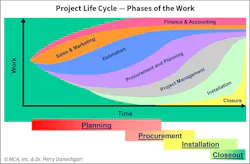
The truth is, before you got onto the job site, the work on the project started. There were relationships to hear about prints, estimates, purchasing plans, and manpower reviews at the division or company level. Before you’re off the job, the work to close out the project will also start. There’ll be continued profit estimates given, parts warranties filed, closeout documents prepped, final billings from suppliers, and transition to service groups. Figure 1 shows the various roles on the project over time and who’s involved.
Use what you have
What do we have in place as our project life cycle? Looking at Fig. 1, does your company have gates/check-ins in place to confirm how the project is running? Think of having affirmative checks or project milestones across the unique teams that have impact on the overall project on:
- Handing off the project from the estimating team to the project management team.
- Kicking off the project from the project management team to the field.
- How you’re going to plan for material, including the buyouts.
- Periodic project reviews — with productivity monitoring (as outlined in “Measuring Productivity vs. Production — What’s the Difference & Why Does It Matter” from the February 2026 issue of EC&M).
- Managing the work itself — do you have a method to plan the work, assign the work, and measure percent completion?
- Job reviews — Is there a dedicated time that the project manager and field lead speak to review recent obstacles, progress on the job, and discuss next steps and follow up? (Read “Making Job Reviews More Effective” from the August 2025 issue of EC&M for more information.)
Be proud of what you have, and take a potential step toward refining and building on what you have. Celebrate the items in place, work on continuous improvement, and share between team members.
You’re running your job. What do you have, and where does it go? How many different locations do you have to get information entered, and who is looking at it? You have:
- Safety planning/documentation.
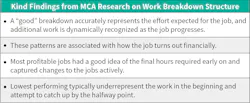
- Work planning — as work break-
down structure documenting everything needed to complete the job as well (see the Table for why this matters). - Manpower planning — over the full job and at a daily level, including timecard approvals.
- Material purchasing — for the field and perhaps for prefabrication.
- Project walks — to do observed percent completes to the plan.
- Daily job reports — some are driven by your company requirements and others.
- HR items inevitably need documentation, review, and storage as well.
Knowing which items are critical for measuring productivity and remaining compliant and safe are important. Are things stored centrally or project-based? Do the right people have access to the information, and is it categorized and codified for action?
What are the critical check-in points?
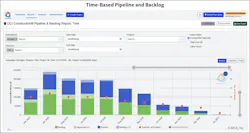
You are comfortable with running the job and the projects, but how does that fit into the company? It’s good to think through how you see the current state as well as the future plans (Fig. 2). Areas to review/assess if you have the necessary visibility are:
Pipeline. What is the estimating team bidding? What pending change-orders are out there that need to be worked through to approval? What’s the likelihood of award, and do we understand our hit ratios across customers, types of work and in different geographical areas, for example.
Backlog. Do we know the accurate start and end dates of our projects? Is our cash flow protected and available to support projects in the future?
Resource planning. How is our labor pool? Are all on the team working on meaningful, profitable work? Do we need more or less people in the future, and is the training in place to support upcoming projects? Is this visible across our team or managed “locally” on spreadsheets and in heads?
WIP/profitability. Do we know what’s spent, what’s still remaining to be spent, and what’s committed/still open? Do we have accurate measure of observed percent complete for billing? Is our under/overbilling managed and understood?
A frequent check-in across the team, with notes/learnings memorialized for future reference is good. Capturing these items centrally and at your fingertips is better. Confirm what’s needed, and get it documented for easier future management and updating.
How are we using software?
Oftentimes, software sees an individual productivity issue and seeks to improve it. While working on individual productivity via training and gaining experience may be useful, it’s truly the system productivity that matters to your business. How does the work flow through your business and operation processes? Without understanding how the work is done, a software will be an add-on and likely won’t be used to its full effect. Also, some software suits/supports certain areas (think estimating, accounting, dispatching, document repositories, productivity management) but may not be required for other departments. This is when it’s good to think through:
- What work needs to be digitalized so that it’s visible by others.
- What work needs to be commonized between groups/teams.
- What work needs to be interconnected. While integrating is on many minds — interconnection is likely what’s needed.
Start where you are, do what you can to take that step
By reviewing and documenting what processes you have in place for your job (installation phase of a project), the project as a whole, as well as your company, it’ll let you get your thoughts in one place for what you have, if it works, and if another step is needed. Reviewing this on an annual basis (if not sooner) to know what your next steps will be to document processes in place as well as those needed is useful. Only after you know what the processes are that you want/need — then you take the step to a right-sized software (with some room for growth) for your business.
About the Author
Dr. Heather Moore
Vice President of Operations
Dr. Heather Moore is VP for Customer Care and Support at MCA, Inc as well as a known researcher and author in the construction industry. Dr. Heather can be reached at [email protected]. She is also part owner of a WBENC certified company, WEM, LLC. that provides logistics and scheduling services for the and is the only licensed reseller of MCA, Inc’s software products that are focused on Making Productivity Visible to Everyone®.
Jennifer Daneshgari
Jennifer Daneshgari is VP of Financial Services at MCA, Inc, whose mission is Making Productivity Visible to Everyone®. She is also a recent contributor for EC&M Asks on the topic of Material Management. Jennifer can be reached at [email protected]. She is also part owner of a WBENC certified company, WEM, LLC. that provides logistics and scheduling services for the construction industry.