Key Takeaways
- Physics-based AI validation is crucial to accurately model real-world constraints and avoid clashes or structural issues.
- Viewing AI as a valuable equipment investment encourages construction firms to adopt technology that directly improves productivity and safety.
- Evolving workflows to incorporate specialized spatial AI can help contractors scale operations, protect margins, and stay competitive.
The construction industry is currently navigating a high-stakes transition. We are operating in an era where technical expertise is being stretched to its breaking point by compressed project timelines, increasingly complex projects like data centers, and a historic, systemic labor shortage. AI is broadly touted as the quick fix to productivity woes but due to skepticism and misunderstandings about the technology, integrating AI is not an easy “yes” for electrical contractors.
A fundamental, high-consequence question remains: When does AI actually reduce operational risk, and when does it introduce time-wasting and potentially dangerous liabilities?
Construction is, at its core, an exercise in risk management. In the electrical trade specifically, where precision is tied to building codes and operational efficiency, there is no margin for error regardless of whether that error originates from a human or a machine. A single design oversight could lead to costly rework, schedule spirals, or worse — unsafe installations that jeopardize a contractor’s reputation.
Closing the productivity gap cannot come at the cost of margins. So, contractors must learn to ruthlessly distinguish between AI that serves as a tool for progress and AI that could be a potential risk.
The liability of generic AI
A wave of “AI-for-construction” software and agentic use cases has recently emerged, much of which was built on large language models (LLMs). These tools play a key role in the modern contractor’s workflow. For example, they are exceptionally powerful for analyzing massive volumes of contract specifications or coding effective project-specific automations. Forward-thinking contractors should be exploring these use cases today. However, the industry faces an automation gap when it comes to the 3D environment.
LLM-based tools are not suited for reasoning through the complex, multi-dimensional physics of a building. This is because these tools are based on probability — they guess the next most likely word or pattern. In the 3D world, guessing can be a liability. For instance, if a conduit run is accidentally designed to go through a structural beam or code compliance is misinterpreted, there can be serious consequences like costly rework and project delays.
For most of the potential construction applications, AI must go beyond LLMs and the agentic tools built on top of them. Instead, the industry requires AI built specifically for the high-stakes certainty of the 3D physical environment.
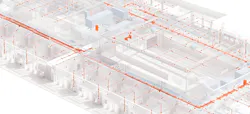
A framework for evaluating AI built for the physical reality of construction
To mitigate risk and meaningfully improve productivity, electrical contractors should evaluate potential AI technologies through a rigorous three-part framework:
1.Trade intelligence vs. generic data. A generic AI might suggest a plausible electrical route, but it doesn’t know the specific clearance requirements for a transformer or the fill capacity of a conduit. Look for technology built specifically on the rules and codes of the industry. The right AI handles these compliance checks automatically, acting as a digital guardrail that prevents violations before they ever reach fabrication. By prioritizing trade-specific logic over generic algorithms, you ensure that every output is a constructible reality that meets the highest standards of precision.
2. Physics vs. probability. Once building code is satisfied, the output must be physically possible to install. Many tools act as visualizers that predict a path based on patterns, which often results in clashes with other trades or structural elements. AI for design automation must be rooted in physics. It treats the building model as a rigid 3D environment with hard physical boundaries. It shouldn’t guess a route; it should validate a solution that accounts for every inch of available space. This ensures that what is modeled is exactly what can be built, eliminating the fabrication friction that traditionally drains profit.
3. The expert-in-the-loop. The ultimate test for any AI is the validation by industry veterans who have spent decades honing the craft. Does the tool leave room for their high-level intent and final validation? A reliable AI workflow is one where VDC teams provide the intent, the goals and constraints, and the 3D AI engine handles the heavy lifting, the routing and spatial calculations. Crucially, preconstruction teams must be able to review and steer the logic. Contractors and VDC managers should be able to verify the technology’s decision-making process at any step.
Evolving workflows to create a competitive advantage with AI
Now that spatial AI has evolved to a state where it can take a significant load off of electrical teams, it’s time to shift the cultural perception of technology in the trades. A construction firm would not hesitate to invest hundreds of thousands of dollars in a high-end scissor lift because the ROI is tangible. AI tooling should be evaluated through the same lens. It’s not an administrative budget line item or an innovation box to check; it’s a piece of valuable equipment. Think of it as another tool in your toolbox like a wrench or screwdriver that ensures teams are being as productive as possible.
Tomorrow’s construction leaders will be those who evolve their workflows to be rooted in intentional, meaningful, applications of new technologies. By choosing tools that elevate human expertise and prioritize trade logic and physics over generic probability, electrical contractors can help eliminate the inefficiencies that create technology risks in the first place. With the right commercially validated spatial AI tools, electrical contractors can scale operations, protect the bottom line, and grow their business.
About the Author

Aaron Szymanski
Aaron Szymanski is a co-founder and head of product at Augmenta. He leads Augmenta’s product definition and design efforts - bridging the gap between computational science, artificial intelligence, and the needs of users and organizations within the AEC industry.
Before Augmenta, Szymanski founded and helmed real/ideal, a strategic foresight and product strategy firm. There he led engagements with clients such as Shopify and Facebook to identify emergent market opportunities and design products for new markets and services.
Previously, Szymanski has worked as an industrial designer at Blackberry designing next generation phones and tablets. He then moved to Xtreme Labs (which became Pivotal Labs through acquisition by Pivotal) where he guided digital product design and development projects for some of the largest banks, retailers and organizations in the US and Canada.
Subsequently at Kinetic Cafe, Szymanski directed the design team and oversaw the development of their connected retail platform. As part of his consulting experience, he collaborated with Francesco Iorio at Autodesk to develop the foundational interaction principles of a new paradigm of human computer interaction: generative design.
He holds a bachelor of industrial design from OCAD University in Toronto. He can be reached at [email protected].