Electrical Troubleshooting Quiz — March 15, 2022
You just completed a service call to a firm with about 25 employees. The firm does small batch custom manufacturing using mostly 3D printers. All the production equipment is in one building and the administrative in another.
The firm is privately owned, and the owners work onsite running the firm. Bob, one of the owners, asked if you might take a look at something. In the administrative building, he takes you down the short, central hallway that connects the two halves of the H-shaped building. Then he stops at the thermostat.
He said they set it for 69°F, but through the winter the office would often get down to 62°F before the heat would come on. Because it’s a heat pump system, the thermostat must be heat pump-compatible. The HVAC contractor they use for the annual furnace check said they could replace the thermostat but it’s $1,200 plus a service call fee plus labor. So instead of spending the money, they used electric space heaters. Then Bob said, “I was floored when I saw the electric bill, and now I want to fix the problem. Do you mind looking at this? Maybe there is something you can do.”
What are some things you could look at before needing to call the office to get the sales department involved?
That pricy thermostat is a high-end version with Wi-Fi for those who want to connect to everything (the Internet of Things). Heat pump-compatible thermostats costing a fraction of that are available. If the existing thermostat doesn’t include Wi-Fi, tell him you’ve already cut a grand off the price. But he may not need to buy anything.
Tell him to go through the setup in the owner’s manual and look for a band setting. It may be in the technician part of the setup rather than the user part. If the setting is there, it will be easy to change. But if this thermostat was there last winter or earlier and only this past winter exhibited this problem, it’s almost certainly not a setting.
Check the airflow
It is almost certainly not an electrical problem at all. He told you the office got down to 62° F, so he must have a thermometer or two out in the office. Look at the thermostat display and note the temperature in the hallway. Then ask him to show you the thermometer(s) in the office. If there’s much of a difference, you are looking at an airflow problem.
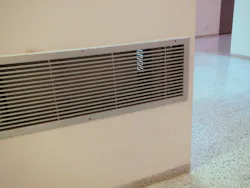
And it is likely caused by blocked cold air returns. Instead of moving through the office spaces to the far side returns, it encounters air that can’t get out. It’s forced back and then out through whatever cold air returns haven’t been blocked. The airflow set up with all this blockage means air that should be flowing across the office spaces to warm them up is circulating in a much smaller loop. And the air moves more slowly, allowing for it to have more time in the hallway to release heat around where the thermostat is.
The most likely culprit is a filing cabinet (or row of them), though it could be a desk or other furniture or even high cubicle walls. If that’s the case here, they probably have a cabinet in front of the breaker panel, so look for it also.
In one of the office areas, look on the wall opposite the registers; it’s where the cold air returns will likely be. If not, think logically of how the airflow was intended and look where the cold air returns would be located to facilitate it. If you can’t see enough return vents (comparable in area to the register vents) but you do see filing cabinets or other furniture along the wall, then you have found why the system isn’t working right.
Tell Bob that if he restores the airflow he can avoid the purchase cost, service fee, and labor for a new thermostat. It might be tempting to take this customer service to the next level and walk him through it, but you are already beyond the level his HVAC contractor should have exhibited, especially since this was an ad hoc situation. You’ve helped him help himself and you’ve saved him some expense
About the Author
 Mark Lamendola
Mark is an expert in maintenance management, having racked up an impressive track record during his time working in the field. He also has extensive knowledge of, and practical expertise with, the National Electrical Code (NEC). Through his consulting business, he provides articles and training materials on electrical topics, specializing in making difficult subjects easy to understand and focusing on the practical aspects of electrical work.
Prior to starting his own business, Mark served as the Technical Editor on EC&M for six years, worked three years in nuclear maintenance, six years as a contract project engineer/project manager, three years as a systems engineer, and three years in plant maintenance management.
Mark earned an AAS degree from Rock Valley College, a BSEET from Columbia Pacific University, and an MBA from Lake Erie College. He’s also completed several related certifications over the years and even was formerly licensed as a Master Electrician. He is a Senior Member of the IEEE and past Chairman of the Kansas City Chapters of both the IEEE and the IEEE Computer Society. Mark also served as the program director for, a board member of, and webmaster of, the Midwest Chapter of the 7x24 Exchange. He has also held memberships with the following organizations: NETA, NFPA, International Association of Webmasters, and Institute of Certified Professional Managers.
Related
 Dreamstime M 63221258
 dreamstime_xl_311647339

