Changes to Dwelling Unit Calculations in the 2026 NEC
Key Takeaways
- The 2026 edition of the National Electrical Code (NEC) includes several structural changes to help align it with proposed restructuring of the 2029 edition.
- Dwelling unit calculations were previously found in Sec. 220.41 but are now located in Sec. 120.41. The biggest change is decreasing the volt-amperes per square foot from 3 VA/ft2 to 2 VA/ft2.
- Unit load calculations have also changed between the 2023 and 2026 editions of the NEC, with significant variation between the two.
- Section 120.13 was added to Art. 120 of the 2026 NEC, ensuring that the total number of branch circuits for a dwelling unit is not reduced despite lowering the volt-amp values in Sec. 120.41.
The “2026 NEC Insider Series” is written by Dean Austin, NFPA Technical Services, Senior Electrical Specialist, Master Electrician, and former Chief Electrical Inspector in the state of Michigan. The series intends to help electrical inspectors, electrical contractors, and electricians understand changes to the 2026 NEC and how all parties can work together, collectively as a team, to provide the safest electrical installations possible.
Safety remains the top priority of the National Electrical Code (NEC), and the 2026 edition includes numerous changes designed to ensure safe electrical installations in our ever-evolving electrified world. This edition also saw structural changes intended to make it easier for users to find information that will help with the installation or inspection of electrical wiring. Some of the structural modifications were also brought in to help prepare the 2026 NEC to align with the proposed restructuring of the 2029 edition of the NEC.
Part 1 of this series addressed changes to arc flash label requirements in the 2026 NEC, located in Sec. 110.16. It ran in the February 2026 EC&M print issue and can be read online at www.ecmweb.com/55343688.
Part 2 focuses on technical changes around calculations that are based on Sec. 120.41 for dwelling unit, minimum unit load, and the new Sec. 120.13 for dwelling unit-branch-circuit loads. While it may seem out of order, it’s easier to start with Sec. 120.41 before reviewing Sec. 120.13. These sections can often be looked at similarly, so let’s take a deeper dive into how they are intended to work.
Changes to Sec. 120.41 (formerly Sec. 220.41)
What was Sec. 220.41 in the 2023 NEC has now become Sec. 120.41 in the 2026 NEC based on Art. 220 being shifted to new Art. 120. The most impactful change to Sec. 120.41 is decreasing the volt-amperes (VA) per square foot from 3VA/sq ft to 2 VA/sq ft, which will directly impact the overall service size of many dwellings.
NEC changes can often be driven by supporting data. In the case of Sec. 120.41, data collected by the Lawrence Berkeley National Laboratory (LBNL) showed 896 occupied U.S. dwellings had a median general lighting and receptacle density of 2.3W/sq ft. This information was presented during the first draft of the 2026 NEC through first revision (FR-8013) and public input (PI-3236), which can be seen at the NEC document information page under first draft report. This data appeared to be the driving force behind the significant change that occurred in Sec. 120.41.
Another piece of data that helped justify the change was the overall wattage decrease for general service lamps due to the energy code being implemented across America. The United States Department of Energy (DOE) has implemented rules that prohibit the sale of general service lamps that do not meet the minimum efficacy standard of 45 lm/W. Most incandescent and halogen type lamps are not able to meet this requirement. This is also why there have been more and more light emitting diode (LED) and fluorescent lamps on store shelves over the past decade or so.
2023 vs. 2026 dwelling unit load calculations
In the 2023 NEC, based on Sec. 220.41, a dwelling minimum unit load calculation for a standard 5,000 square foot home with a 120V/240V, single-phase electrical service would look like this:
- 5,000 sq ft x 3VA/sq ft = 15,000VA ÷ 240V = 62.5A
For the 2026 NEC, based on the modifications in Sec. 120.41, the calculation for the same home would be:
- 5,000 sq ft x 2VA/sq ft = 10,000 VA ÷ 240V = 42A
So, as you can see, there is a significant variation in the total volt-amps and ampacity load in this calculation under the 2026 NEC. This variation could be the determining factor between two different service sizes and likely a smaller feeder conductor size. This could mean dollars saved for both the customer, whether that be a homebuilder or homeowner, and the electrical contractor. It is also important for inspectors to be aware of this change when reviewing electrical plans for the dwelling unit load calculation.
Informative Annex D1(a) and D1(b) in the 2026 NEC are great resources that contain examples of dwelling calculations for the entire home to help further explain how a calculation is done.
New Sec. 120.13
For the 2026 NEC, new Sec. 120.13 was added to Art. 120. It is important to first understand that the calculation being done in Sec. 120.13 is not factoring into the overall dwelling load calculation. This calculation is being used to determine the proper number of dwelling unit branch circuits. A branch-circuit load calculation must be performed based on 3VA/sq ft multiplied by the calculated square footage of the dwelling unit, based on Sec. 120.5(C). A calculation could look like this:
- 5,000 sq ft dwelling unit × 3VA/sq ft = 15,000VA ÷ 120V = 125A
- For 15A, 2-wire circuits, the formula would be: 125 ÷ 15 = 8.33, meaning this would require at least 9 total 15A, 2-wire branch circuits
- For 20A, 2-wire circuits, the formula would be: 125 ÷ 20 = 6.25, meaning this would require at least 7 total 20A, 2-wire branch circuits
These branch circuits from Sec. 120.13 would be in addition to those listed from the required branch circuits in Sec. 210.11(C):
- Small-Appliance Branch-Circuits (minimum of two)
- Laundry Area Branch-Circuit (minimum of one)
- Bathroom Branch-Circuit (minimum of one)
- Garage Branch Circuit (minimum of one)
Based on the branch circuits calculated in accordance with Sec. 120.13 and the requirements of Sec. 210.11(C), the electrical panel in this dwelling unit could contain between 12 and 14 single-pole breakers, in addition to circuits for appliances such as ranges, dryers, and dishwashers. The purpose of adding Sec. 120.13 was to ensure that the total number of branch circuits for a dwelling unit is not reduced, even though the volt-amp values in
Sec. 120.41 were lowered. Reducing the calculation from 3VA/sq ft to 2VA/sq ft could lead to fewer general-purpose branch circuits being required. This, in turn, could result in overloaded circuits, which is why maintaining an adequate number of branch circuits remains a critical focus.
Enforcement of the NEC change
The changes to these Sections will be something that electrical contractors, electricians, and electrical inspectors who are performing residential work will need to be aware of. It would be ideal to have both Sections that changed verified during the plans review stage or, at a minimum, during the rough-in stage when electrical plan review is not necessary for new residential homes within a jurisdiction.
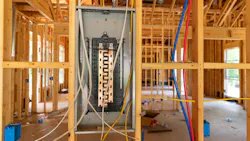
One suggestion to comply with meeting the proper number of branch circuits might be to have all branch circuits installed on circuit breakers in the electrical panel during the rough-in inspection stage, so the electrical inspector can ensure the proper quantity of branch circuits is present before wall coverings, like insulation and drywall, are installed. After all, finding a violation after this stage of a project may become a difficult and costly remedy.
Potential impact of the NEC change
The overall positive impact of these changes on the industry includes the potential for reduced overall electrical service sizes due to the lowered volt-amp (2VA) requirements outlined in Sec. 120.41, which could help reduce overall construction costs. Additionally, the addition of Sec. 120.13, along with the use of a higher volt-amp (3VA) rating, will help ensure an adequate number of branch circuits, reducing the likelihood of homeowners experiencing circuit overloading.
Important Notice: Any opinion expressed in this column (blog, article) is the personal opinion of the author and does not necessarily represent the official position of NFPA or its Technical Committees. In addition, this piece is neither intended nor should it be relied upon to provide professional consultation or services.
About the Author
 Dean Austin
Dean Austin
Dean Austin is a senior electrical content specialist at the National Fire Protection Association (NFPA). In his current role, he serves as an electrical subject matter expert in the development of products and services that support NFPA documents and stakeholders. Dean has more than 30 years of experience in the electrical industry, holding a master electrician license, an electrical inspector, and an electrical plan reviewer registration in the state of Michigan. He taught electrical apprentices for 10 years in the Associated Builders and Contractors’ electrical apprentice program. For 11 years, he was an electrical inspector for the state of Michigan, and for five years, as the chief of the electrical division within the Bureau of Construction Codes at the state of Michigan. At the state of Michigan, Dean was charged with enforcing the laws, rules, and codes governing electrical installations and licensing within the jurisdictional boundaries of the state of Michigan.