
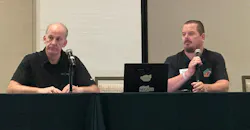
Every three years, the electrical industry gears up to adopt a new edition of the National Electrical Code (NEC). Since the 2026 NEC came out in September 2025, electrical professionals have been hungry for guidance on how to apply the latest revisions to the new Code in the field. That enthusiasm was evident by the participation in an early-morning educational session on Day 3 of the NECA 2026 show in Las Vegas.
Presented by Kyle Krueger, NECA’s executive director of codes and standards, and Alan Manche of Schneider Electric, “The 2026 NEC: Key Changes Every Electrical Contractor Should Know” drew a large crowd. Breaking down some of the most significant revisions in the latest edition of the Code, the pair highlighted changes affecting electrical protection, grounding, system design, and everyday field applications.
Emphasizing that the 2029 NEC will undergo some major restructuring, the presenters encouraged attendees to familiarize themselves with process. According to NFPA, “the long-term plan for the 2029 edition of the NEC is to add new chapters, reorganize existing content within new chapters, and provide more visibility and insight into the Code, including on topics such as limited-energy and installations over 1,000V.” The reorganization is already underway, beginning with the 2023 edition, with more foundational work occurring in the 2026 edition.
“This [restructuring] allows us to actually back up and look at the information and say, how do we group things -- and how do we put things in place so that you, as the user, can get the things quicker,” said Manche. “The electronic tools that are going to continue to rise with the use of AI and other tools can identify and roll out the structure of a document, but there’s a lot staying the same.”
Krueger and Manche highlighted several significant revisions to the 2026 NEC that electrical contractors should be familiar with including:
Sec. 110.16 [Arc Flash Hazard Marking]. The threshold of marking equipment rated 1,000A or more has been removed, and all non-dwelling unit service and feeder equipment will require arc flash marking.
NEC restructuring [Articles 120 and 130]. The speakers explained that restructuring is necessary to facilitate the grouping of requirements in a manner that also supports future innovation. They noted that electronic delivery of the NEC will also benefit the next generation of Code users, and expect energy management systems to become a common feature of modern power systems with on-site generation.
Load calculations [Sec. 120.1]. Updates to the hierarchy diagram provide clear guidance on how special installations, such as health care facilities, fit into overall load calculation requirements. According to the presenters, grouping the load calculations for common load types into Art. 120 provides consistency and safety across various installations or applications (e.g., the general lighting load for office areas applies regardless of the installation type).
Load calculations [Sec. 120.7]. The setting of a power control system (PCS) can be used in place of other methods in Article 120 in load calculations for branch circuits, feeders, or service equipment.
Branch circuits [Sec. 210.8(F)]. The general rule requires GFCI protection for all outdoor outlets at dwellings. Listed HVAC equipment has an exception, which expired September 1, 2026. However, a new exception permits listed Class C SPGFCI for HVAC equipment. According to the presenters, Exception No. 3: Listed Class C SPGFCI protection shall be permitted for listed HVAC equipment if a Class C SPGFCI is provided, and the disconnect serving the HVAC equipment shall be marked “Warning: Class C SPGFCI Protection Provided for HVAC Unit.”
Surge protection [Sec. 215.18(A) & 230.67(A)]. Feeder surge protection has been expanded to include areas that are similar to a bedroom. According to the speakers, the revised language brings the terms in alignment with building code and other standards.
Service disconnecting means location [Sec. 230.70(A)(1)]. Service disconnects must be installed in a readily accessible outdoor location either on the dwelling unit or within sight of the dwelling unit. This change removes the allowance for the service disconnect to be inside nearest the point of entrance of the service conductors. A new exception was added for feeder supplied dwellings if an emergency disconnect is installed in accordance with Sec. 225.41. For one- and two-family dwellings, the service disconnect and the emergency disconnect requirements have been merged. The service disconnect will also serve as the emergency disconnect.
Emergency systems [Sec. 700.6(C)]. The ability to perform service to transfer equipment must be provided with permanently installed equipment. The list of exceptions was removed with the requirement now applying to assembly occupancies, educational occupancies, and high-rise buildings.
Since every new edition of the Code comes with a new collection of requirements for electrical contractors to understand and implement, it’s important to stay up to date on the latest revisions to avoid potential compliance problems for those who are not prepared.
About the Author
 Ellen Parson
Ellen Parson
Editor-in-Chief - EC&M
Ellen Parson is the Editor-in-Chief for EC&M. She has a journalism degree from the University of Missouri-Columbia. She's been a business-to-business writer and editor for more than 25 years, most of which have been covering the construction and electrical industries. Contact her at [email protected].