Thoughts from Las Vegas: Key Takeaways from NECA 2026

Weeks before NECA’s Annual Convention & Trade Show took place on October 4-7 in Las Vegas, the association had touted the highest registration numbers ever. Although no final NECA attendance numbers were available as of this writing to confirm if this year truly broke records, I can attest to the fact that the show was booming. From my perspective (and past attendance at this show for decades), foot traffic from attendees on the show floor definitely seemed up (especially the first two days), attendance from conference goers at more than 80 educational sessions also seemed stronger than usual, the number of exhibitors was high at more than 400, and the number and variety of new product introductions on display were significant.
In addition to these general observations, there was one recurring theme I couldn’t ignore. Whether I was talking to product managers at booths while canvasing the exhibit hall floor, interviewing subject matter experts on what to watch this year, or attending educational sessions on the latest trends poised to affect electrical contractors the most, everything kept leading back to artificial intelligence. I couldn’t help but notice what seems to be a shift in the way our industry is thinking about AI — no longer is it a single futuristic topic that appears on the agenda. Electrical contractors — and the OEMs who make the electrical equipment they install — are moving past general conversations about AI into a much greater level of specificity. I heard contractors asking about where and how AI can produce measurable value in their organizations, what information it requires, how they can protect their data, and which decisions should remain with experienced professionals.
That evolution builds on trends EC&M documented earlier this year in the January 2026 article, “Inside the Electrical Industry’s AI Learning Curve,” which examined how electrical professionals were using AI to automate repetitive tasks, retrieve internal knowledge, analyze project information, and support design workflows. The AI educational sessions at NECA reiterated these themes and offered more specifics on how to implement AI in business operations, data management, project delivery, and custom applications. Here are a few takeaways I learned from attending these three AI-related sessions.
Judging by how full this session was at 8 a.m. on the first day of the convention, I’d say the topic of “Key AI Functions for Electrical Contractors” is definitely resonating with our audience. In the presentation, Christopher Carr, President & Co-Founder of Dynaimix AI, outlined the capabilities, tools, and processes involved in adoption. The session focused on identifying valuable workflows and developing an implementation roadmap.
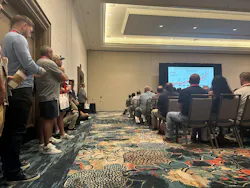
When speaking about transformational AI, Carr explained how the technology makes thing possible that previously seemed like science fiction. “Every task becomes a tool,” he said. “With transformational AI, we're now able to unlock things that were never possible before.”
Carr took attendees through his “AI Implementation Benchmark,” walking the group through an exercise on how to score their own companies in several key areas (including AI literacy, governance, shadowing, personal AI roadmaps, department AI tools, enterprise AI tools, accelerated communication, and continuing education) in order to see how they compare with their peers when it comes to AI.
Carr showed a video from Anthropic CEO Dario Amodei that predicted the point at which artificial intelligence could match or surpass human capabilities in almost all domains. “It is my guess that by 2026 or 2027, we will have AI systems that are broadly better than almost all humans at almost all things,” he said.
He took that prediction a step further, challenging electrical contractors to reimagine how they think about AI even though the human inclination would be not to go all in because we just don’t know what’s going to happen. Given the fact that the technology is now rapidly becoming smarter than the people who brought it into this world, Carr thinks those who are proactive will come out on top. “The gap is expanding among contractors, and most don’t realize it until it’s too late,” he warned. “The pace of AI growth is exponential.”
In “AI Starts with Discipline: How Electrical Contractors Must Prepare Their Data, Documents, and Teams Before Using AI,” examined how inconsistent documents, poorly structured data, and misaligned workflows limit the technology. Jeff Burmeister of Egnyte and Jeff Sample of Bluebeam (who led the presentation) offered strategies for standardizing data, improving document control, and aligning employees.
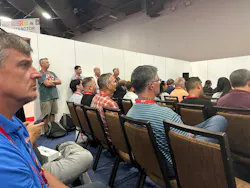
Sample took the standing-room only audience through a series of real-world poll questions in order to uncover whether their companies are actually ready to use AI or not. When asked which electrical workflow has the biggest opportunity for AI, the group clearly named estimating and takeoff by a significant margin, followed by drawing and specification review, coordination, RFIs and submittals, change management, and prefabrication.
Sample, a technology evangelist, speaker, podcaster, and expert at driving digital workflows in construction, is the Senior Industry Development Manager Trades at Bluebeam. He encouraged attendees to really think about what problems they want to solve before developing an AI strategy. “It is not magic. It is 1s and 0s. It is computer programming. It follows a sense of logic,” he said. “It is just a tool for us to use. So you have to decide how do you want to use that tool?”
Sample continued with a discussion of the importance of not only the accuracy of the data fed into the AI but also the context of what that data means. Noting that too many of the big electrical contractors in the industry have an issue with consistency, he maintained the importance of quality data, asking attendees how many of them really trusted the systems they use day in and day out at work completely. “Very few, right?” he quipped. “We have an inconsistency with the way we do things; we do things differently in different areas of our company, and we don’t always document them,” he said. “Efficiency is not effectiveness — remember, AI can scale the wrong process.”
In “Going Beyond Chat Bots: How Spatial AI Delivers Quantifiable ROI and Operational Excellence in Construction,” OpenSpace Co-Founder and CEO Jeevan Kalanithi explored how visual and location-based information can reduce rework, improve collaboration, deliver real-time insights, and lower costs and risk. He began the presentation by introducing two key trends that are defining this decade when it comes to AI: agentic AI is an unstoppable trend that’s changing broad parts of the economy, and visual intelligence is eliminating laborious text-first methods.
“So the first component of visual intelligence is just incredibly easy to have a complete visual record of everything — inside and out,” he said. “Then you can see what’s there. It’s kind of the base layer.”
However, he warned that although AI can seemingly “do anything,” it needs accurate and consistent data to do so. “The key thing is this: It’s only as good as the data that these agents have access to.”
Kalanithi went on to say that he believes in order for full AI adoption to occur in the electrical contracting community, three things have to happen: 1) the input data for the AI future must include field data (visual, reality data); big leaps in risk reduction, labor costs, and more may be on tap; and none of this will materialize without strong field love and acceptance.
Based on the key takeaways from these sessions and more I attended at NECA 2026, AI remains a tool rather than a substitute for construction knowledge. Its value depends on the quality of the information behind it, the suitability of the workflow around it, and the judgment of the people responsible for that final decision. But if the extent of AI programming at this year’s show is any indication, the technology is moving rapidly from a side experiment into an operating capability electrical contractors will be expected grasp in order to stay competitive.
About the Author
 Ellen Parson
Ellen Parson
Editor-in-Chief - EC&M
Ellen Parson is the Editor-in-Chief for EC&M. She has a journalism degree from the University of Missouri-Columbia. She's been a business-to-business writer and editor for more than 25 years, most of which have been covering the construction and electrical industries. Contact her at [email protected].