Key Takeaways
- Routine tasks can lead to complacency, increasing the risk of workplace incidents if not managed properly.
- Pre-task planning, including hazard elimination and team communication, is essential for safe electrical work.
- Attention to detail, such as filling out lockout/tagout tags and updating warning labels, helps prevent electrical accidents.
- Utilizing safety technologies like wearable voltage detectors adds an extra layer of protection against human error.
- Encouraging near-miss reporting without fear of discipline fosters a proactive safety culture and continuous improvement.
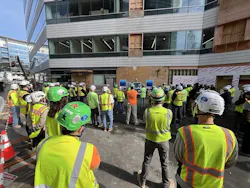
Experience is a great way to avoid unnecessary risks. It’s also a great way to take unnecessary risks because if you can do something in your sleep, you might be sleepwalking into danger. In fact, when EC&M asked safety and risk management experts to list the top reasons for workplace incidents, the same word kept coming up.
“Complacency is probably the biggest driver for risk in any job,” says Kevin Kolhonen, JM Electrical Company health and safety manager. “With the mundane day-to-day tasks, people tend to get into routines.”
“Complacency and assumptions are surefire ways to increase risk,” says
D. Scott Risch, Rosendin Electric senior vice president of health, safety, and environmental.
“Complacency stemming from routine work, often reinforced by repeated success despite unsafe behaviors,” says Travis Keeney, Tri-City Electric vice president of risk management.
As counterintuitive as it might sound, they also agree that certain other types of routines can mitigate risk.
“The biggest thing is breaking that and getting people thinking: speaking with crews, meeting with foremen on-site, and driving home pre-task plans,” Kolhonen says. “Every day before you start work, eliminate the hazards that you’re going to be diving into throughout the job.”
Rosendin Electric’s pre-task work plan is a two-day process.
“Our foremen begin preparing and planning the day before to ensure everything has been considered before crews arrive, ready to work,” Risch says. “After reviewing the plan and discussing, our crews inspect their tools and equipment and verify that their work area is free from hazards. Neglecting lockout/tagout (LOTO), working on live equipment, ignoring clearances, or using damaged tools and cords are all hazards that can and should be identified before the work begins.”
A team effort is key.
“We treat mental health as seriously as physical health,” Risch says. “Checking in with team members is an important part of preparing for the day ahead. Sometimes our colleagues have an off day and aren’t as focused as usual. We follow two-person verification for all high-risk activities.”
Daily pre-task planning is also an ideal opportunity to consider how change-orders affect safety requirements.
“Formal stop points are implemented whenever the scope of work changes,” Keeney says. “At these points, crews regroup to reassess conditions, identify any new hazards, and develop appropriate mitigation strategies before proceeding with the revised task.”
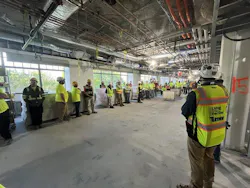
Every detail counts
Another common recommendation is that details matter. For example, don’t leave LOTO tags blank.
“Make sure you actually fill out the tag so somebody can contact you,” Kolhonen says. “A lot of people miss that step even though it’s so simple.”
Labels for arc flash and shock are another important detail.
“NFPA 70B, the standard on electrical equipment maintenance, and NFPA 70E, the standard on electrical safety in the workplace, don’t differentiate between the maintenance required for temporary power systems as opposed to permanent power systems,” says Lanny Floyd, who’s spent nearly a half-century as a workplace and occupational electrical safety expert. “I often see temporary power systems strung up on substandard construction sites. They have not been maintained for a while. Arc flash and electric shock warning labels should have a date on them, and that date should not be older than five years. That’s something to look for as you walk around a facility.”
Completing LOTO tags also highlights how electrical can help other trades work safely.
“About half of the electrocutions in the U.S. occur in construction,” Floyd says. “According to OSHA and BLS data and reports from the Electrical Safety Foundation International, about half of the electrocution fatalities each year are not electricians — they’re everybody else. They’re the painters, truck drivers, carpenters, scaffold erectors. About half of the fatalities each year are due to contact with overhead power lines.”
Pre-task planning is an ideal time to identify those kinds of risks.
“When walking around the facilities, where do you have exposure?” Floyd says. “Where there’s vehicular traffic underneath area lines, and how is that exposure controlled? Those routes need to be identified and controls established to prevent vehicle and personnel contact.”
Getting input from the general contractor and other trades helps identify those risks, such as where boom trucks will drive and park to load drywall up to the third story. Those interactions are also opportunities to understand each trade’s power requirements so they don’t rig up their own to keep on schedule.
“The first step is to meet with the general contractor to fully understand their temporary power needs,” says Rosendin’s Risch. “Next, install sufficient receptacles for cordless tool battery charging stations for projects that are going cordless, designated areas for charging mobile elevated work platforms, and receptacle banks in sufficient quantity to prevent the excessive need for daisy-chained extension cords.”
GFCIs are another must-have safeguard.
“The GFCI is probably the single most important advancement in electrical safety technology in the last 100 years,” Floyd says. “We need to go beyond compliance. Don’t just make sure they’re where the Code says they need to be. Make sure that there are GFCI-protected circuits in all locations where a person could be holding a cord-powered tool or extension cord and be in a conductive grounded environment, such as standing on concrete, metal grating, or earth.”
PPE for POE
Installing surveillance cameras, alarms, and Wi-Fi access points involves working with low voltages and near high voltages. One obvious reason is that 120V is often in the same enclosure as the low-voltage wiring. Other reasons are less obvious, which is why they can be debilitating or deadly.
“We had a guy working up in a ceiling, and there was an open box in the ceiling that was making contact with the sprinkler pipe,” says JM Electrical’s Kolhonen. “So that whole pipe became energized without him knowing. He made contact and got hurt pretty bad. He was up on a ladder, and a guy had to kick the ladder out from beneath him because he was locked up on the live voltage. People overlook the dangers of working up in the ceiling.”
A Tri-City electrician had a near miss while working on low voltage above a drop ceiling. Another firm had the electrical contract and left some fixture whips hanging down. That circuit was supposed to be off, but it wasn’t. Those are among the hazard scenarios that make the case for smart PPE, the topic of a May 2025 EC&M feature, “Tracking Wearable Safety Tech Trends.”
“As an added safeguard, Tri‑City leverages technology, such as wearable voltage detectors, as a final line of defense against human error,” says Keeney.
Some wearables are wristwatch style. As the hand approaches an energized source, it buzzes or beeps a warning to stop. Other types are worn on hard hats. One benefit of the wristwatch is that it stops the hand before it makes contact, thus blocking the current’s path through the heart as it goes to ground.
Appeal to the bottom line
As crass as it might sound, there’s a solid business case for investing in safety programs and technologies, starting with keeping workers’ comp and other insurance premiums in check. Potential customers also frequently look at safety records because they don’t want accidents delaying their projects or forever having them remembered as the place where workers died.
Getting customers to consider their own bottom line can boost safety. An example is hospitals whose century-old buildings have been periodically remodeled and expanded since electric lighting went mainstream in the 1880s.
“Especially in the Northeast, a lot of these buildings are very, very old,” Kolhonen says. “If you get a job in an older building that you’re not familiar with, you really have to do a full risk assessment to make sure that you’re not going to run into any situations where you open up a panel, and God forbid something lets go.”
The building owner can — and should — do its part by facilitating the risk assessment.
“It is the responsibility of the facility owner or manager to maintain documentation like single line drawings, panel directories, that sort of thing, so the maintenance and construction work can be planned safely,” Floyd says.
A remotely operated cutter protects electricians if it turns out that a line is energized when it’s thought to be in an electrically safe work condition. This tool will protect the workers’ exposure to an energized conductor, but cutting an energized line will result in a power outage with potentially serious consequences to facility operations.
“It can be an outage to a critical part of the hospital,” Floyd says. “Property owners need to understand the consequences of a mishap in their electrical systems. There needs to be a discussion over how an accident could impact operations and be prepared for that. I’ve seen [situations] where, when the owner truly understands what the consequences are, they have a different attitude on allowing energized work in the facility.”
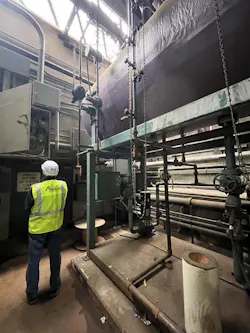
Near misses and missed opportunities
Unless a mistake, a habit, a shortcut, or something else results in injury or property damage, it’s a near miss that no one else knows about — and that no one else can learn from.
“Electrical accidents are one of the lowest frequency injuries in the OSHA lost time injury database: about one in 500,” Floyd says. “They don’t happen very often, but near misses happen quite frequently. If you don’t learn from the near misses, that leaves you from learning just from the very bad accidents. The culture to encourage near miss reporting, called psychological safety, has to be established by the top management. People need to be congratulated for reporting near misses. And the more you can learn from near misses, the more opportunities to identify gaps and deficiencies and the less likely you are to have a serious electrical accident.”
That starts with creating a company culture that puts safety first — including ahead of discipline.
“One unique approach we take at Tri-City Group is encouraging near-miss reporting through a zero‑disciplinary program,” Keeney says. “When an employee self‑reports a near miss that does not result in injury or property damage, we commit to focusing on the lessons learned and how we can improve moving forward, rather than assigning fault or emphasizing mistakes.”
Rosendin takes a similar approach.
“Near misses are treated as learning opportunities, not opportunities for repercussions,” Risch says. “Our focus is on serious injury or fatality (SIF) prevention. It’s prevention through identification, communication, safeguards, safeguard verification, and SIF reporting. We encourage reporting, reviews, and analysis of near misses and turn them into training topics and process improvements.”
Safety and risk managers play a pivotal role in getting employees comfortable with sharing their near misses.
“A lot of safety professionals make the mistake of trying to become like a safety enforcer,” says JM Electrical’s Kolhonen. “The position isn’t really about that. It’s more about kind of teaching the guys in the field. It really comes down to having an open communication line, especially with the foremen. You’ve got to build those relationships and tell them if there’s a situation, feel free to stop work. That goes for anybody in the field. Stop work if you’re not comfortable with what’s being asked of you, and let’s come up with a better game plan.”
About the Author
Tim Kridel
Freelance Writer
Kridel is an independent analyst and freelance writer with experience in covering technology, telecommunications, and more. He can be reached at [email protected].