Key Takeaways
- Assembled panelboards reduce onsite assembly time, allowing electricians to focus on high-value tasks and accelerate project completion.
- They improve schedule certainty by delivering fully assembled, tested, and code-compliant units, minimizing delays caused by missing or damaged components.
- Off-site assembly simplifies logistics, reduces waste, and lowers costs, contributing to more predictable project management and better resource allocation.
- Material availability and coordinated procurement are vital; suppliers offering inventory visibility and timely delivery help prevent delays and rework.
- Adopting assembled panelboards and strategic material management enhances project agility, making electrical construction more resilient to industry-wide labor and supply chain challenges.
Electrical contractors are being challenged to deliver more projects on tighter schedules at a time when labor availability, material lead times, and power demand are creating intersecting pressure points. Global electricity demand is projected to grow substantially through 2030, driven by data centers, advanced manufacturing, electrification, and other complex applications. At the same time, contractors continue to face workforce constraints and long lead times for critical electrical equipment.
In this environment, traditional field-based assembly models can create unnecessary risk. When skilled electricians spend valuable job-site hours sourcing components, assembling panelboards, or troubleshooting missing parts, project schedules become more vulnerable to delays. Contractors need approaches that improve predictability, preserve labor capacity, and make electrical installation more agile.
Practical strategies include shifting panelboard assembly off-site and purchasing from distributor inventory rather than ordering directly from the factory. Assembled panelboards can help contractors optimize field installation, simplify logistics, and improve schedule certainty — not by replacing skilled labor, but by allowing crews to focus that labor where it delivers the greatest value.
Assembled panelboards: agile assembly in action
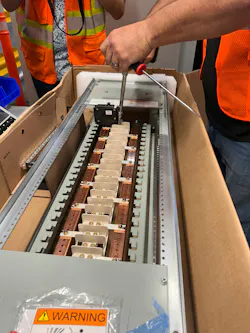
In electrical construction, agile assembly means moving repeatable, component-heavy work into a controlled environment while maintaining the flexibility to adapt to project-specific requirements, delivery schedules, and material availability. The value of assembled panelboards is not simply that they arrive faster. The greater advantage is that they reduce the number of variables a contractor must manage in the field. Instead of coordinating separate components, allocating skilled labor to repetitive assembly tasks and absorbing schedule risk when one part is delayed, contractors can receive a more complete, installation-ready package.
Some of the key benefits to relying on assembled panelboards allow contractors to:
- Optimize labor: Assembled panelboards can keep work flowing by removing much of the onsite assembly. Panels arrive in the field fully assembled, meaning electrical workers can move through the installation process — and to the next job — much faster. By shifting time-consuming, repetitive work into a controlled, off-site environment, skilled workers are empowered to instead focus on high-value tasks. Even if contractors have their own pre-fab shops, relying on partners to handle the assembly portion can enable them to use their own labor more efficiently.
- Stay on schedule: Given the mounting pressure to execute projects faster, assembled panelboards (delivered with circuit breakers, labeling, and all components installed and tested) also ensure a more predictable installation schedule, helping to keep projects moving on time. Additionally, less time is spent waiting on individual components to arrive at the job site.
- Mitigate risk: By relying on assembled, Code-compliant panelboards, contractors are also in a better position to mitigate the risks related to project timelines and material availability. While traditional installation involves managing dozens of individual components, assembled panelboards consolidate installation, ensuring fewer missing parts, cleaner job sites, and lower risk of damaged components. Since the panelboards already arrive assembled to spec, rework is minimized as well.
- Simplify logistics: Assembled panelboards simplify logistics and support more accurate labor planning to streamline project management. Resources are better allocated, and less is spent on excess materials and labor. Additionally, moving the assembly component to partners can minimize the impact of last-minute demand on contractors who may have their own pre-fab shops. And because these panels are already in stock, they can ship much faster, alleviating potential lead time issues.
When combined with reduced material waste and faster installation, the total cost savings can quickly add up, making a measurable difference to the bottom line. And, given that assembled units are built to spec, tested, and Code-compliant before they are shipped, contractors face fewer inspection failures, errors, and callbacks.
Why material availability is part of the assembly strategy
The most successful electrical projects depend on more than off-site assembly — they also depend on material availability. Back-office tasks like inventory management, order tracking, and vendor coordination all have a direct impact on job-site productivity. A significant number of parts go into a panelboard, often requiring specific components such as exact breakers, appropriate lugs, and correctly rated enclosures. Managing all components — and making sure each arrives at the job site at the right time — is a heavy burden that can easily lead to delays if materials aren’t available or delivery times aren’t coordinated.
Off-site assembly is only as effective as the material strategy behind it. Contractors should look for partners that can provide visibility into inventory, coordinate order fulfillment, and support project-specific requirements before materials are needed in the field. This may include procuring enclosures earlier in the project cycle, standardizing box sizes where appropriate, staging related components, and aligning delivery with installation milestones.
The goal is not simply faster shipment. It is a more coordinated approach to procurement, assembly and delivery — one that reduces the likelihood of missing parts, idle labor, and schedule disruption. Collectively, these capabilities create agile assembly, a more resilient and sustainable way to execute electrical construction projects.
As electrical projects become larger, faster, and more complex, contractors cannot afford to let repetitive assembly work, fragmented procurement, or missing components dictate job site productivity. Assembled panelboards offer one way to reduce that variability by shifting assembly into a controlled environment and aligning material availability with project schedules. As demand for power continues to grow, that kind of agility will become increasingly important to delivering projects with the speed and certainty today’s market requires.
About the Author
 Sean Grasby
Sean Grasby
Sean Grasby is a transformative leader with more than 20 years of experience driving business growth and strategic innovation across diverse industries, currently serving as the Senior Vice President & GM, US Construction and Wesco Energy Solutions. Previously serving as President of EECOL Electric, he guided the organization's strategic direction for the past five years. Previously, Sean was President and CEO of Xperigo, where he spearheaded innovative mobility solutions for automotive partners. His strategic vision and execution expertise fueled business transformation and significant global growth.
Sean's leadership background also includes senior roles at Grainger Canada, transforming the Customer Solutions Group, and engineering and leadership roles in the automotive sector with Cooper-Standard Automotive and Travos Automotive. As a leader, Sean drives a culture of collaboration, innovation and excellence, empowering teams to thrive. He currently serves on the Board of Governors, Risk and Audit Committee for AMA - Alberta Motor Association and has been a Mentor with Futurpreneur and an Entrepreneur-in-Residence at the Ivey Business School at Western University for the last decade. Sean has a B.Sc. degree from the New York Institute of Technology and an MBA from Ivey School of Business.