Illustrated Catastrophes: A Homeowner’s Not-So-Handy Work
All references are based on the 2020 edition of the NEC.
A Homeowner’s Not-So-Handy Work
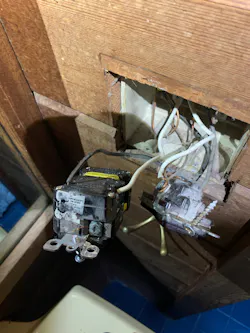
Rob Paglucia, a master electrician from Massachusetts, was kind enough to share this interesting photo. He said, “I came across this the other day. The customer lost the neutral to the bathroom lighting circuit, so he connected the neutral from the vanity light fixture to the ground... and it worked. Not to mention half the grounds in the house weren’t connected.”
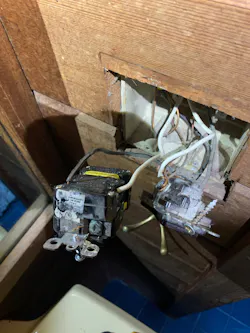
There are lots of violations to point out here. Connecting the grounded neutral conductor to the equipment grounding conductor (EGC) in this location on the load side of the service is a violation of Sec. 250.142(B). Terminating three conductors under a terminal designed for one EGC is a violation of Sec. 110.14(A). The lack of any EGC connection to the receptacle grounding terminal is a violation of Sec. 406.4(B). Using wood screws instead of the supplied 6/32 machine screws to secure the switch violates Sec. 404.10(B). The outlet box is set back from the finished wood surface, which is a violation of Sec. 314.20. A listed box extender or extension ring could be used to solve this problem. Thankfully, Rob was able to make the appropriate repairs needed to make this installation safe.
Epic ENT Failure
Mason Flanagan, a master electrician with Sully Electric and Controls, Inc., Sully, Iowa, sent me this photo. According to Mason, this installation is located outdoors on a grain bin. He stated, “They ran ENT unstrapped and no fittings as a sleeve over individual THHN wires and then a clamp connector in the top of the box on the THHN and the clamp wasn’t tightened so the box is full of water.”
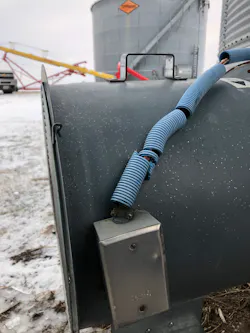
Installing ENT in this outdoor location is a violation of Sec. 362.12(7) since it is not identified for this purpose. The damage to the ENT indicates to me it should not have been used here because Sec. 362.12(8) prohibits its use where exposed to physical damage. I’m not sure if this area is a hazardous location, but it is a possibility if the grain is being stored or processed at this location. Section 362.12(1) generally prohibits the use of ENT in hazardous locations. The failure to secure and support the ENT violates the requirements in Sec. 362.30(A) and (B). Using box connectors designed for wiring methods other than ENT is a violation of Sec. 300.15.
About the Author
 Russ LeBlanc
Owner
Russ started in the electrical trade as an apprentice in 1985. He worked his way up to become a Journeyman Electrician and then eventually became a Master Electrician and Licensed Construction Supervisor. In 1999 Russ become an Electrical Instructor for The Peterson School of Engineering in Massachusetts where he developed his passion for teaching, and quickly became Department Head of Electrical Instruction. Russ has taught thousands of apprentices, electricians, engineers, inspectors, and other electrical professionals during his career as an instructor. He continues to provide electrical professionals with Electrical Code seminars, Arc-Flash Awareness training seminars and educational material through his LeBlanc Consulting Services in North Reading, MA whose specialty is educating electricians. He has been an active member of the NFPA Electrical Section and has authored hundreds of National Electrical Code proposals and comments which have become Code rules to improve the safety for the electrical industry. Russ is also an IAEI certified Electrical Inspector.
Please visit www.russleblanc.net for more information.