Illustrated Catastrophes: Foiled by the Installer
Foiled by the Installer
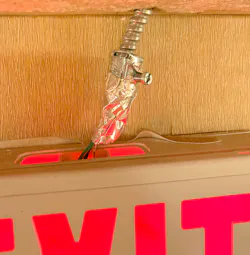
This photo was sent in by Robert Lengfelder. He’s a vice president for RGLA Solutions, Inc., in Schiller Park, Ill. He discovered this as he was walking to his hotel room. “It looked like a whip was installed down from the ceiling, and it wasn’t long enough — so they wrapped the exposed wires with aluminum tape to conceal it. I was surprised that an inspector didn’t catch this.”
Robert, luckily your keen eye spotted this unique installation, and you shared it with us. Thanks for doing so.
Wrapping aluminum tape around some conductors is certainly not one of the wiring methods specified in Chapter 3 of the NEC. Section 310.10 gives permission to install individual conductors in any of the wiring methods covered in Chapter 3. Since you won’t find aluminum tape there, we can also look to Sec. 110.8, which lets us know that only suitable wiring methods are included in the Code. The gaping hole in the top of the exit sign could be problematic in the event of any arcing or sparking inside of the sign. Section 110.12(A) requires openings to be closed in a manner equivalent to the wall of the equipment.
Rogue Receptacle Installation
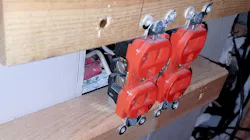
Brandon Spivey, owner of Event Horizon & Services in Nashville, Tenn., was kind enough to share this photo with us. He said, “The plugs were covered with a fabric panel with no other housing.” Brandon also said he is “new to this all, and learning, but this seems like a Code violation.” Brandon, you are correct. There are definitely Code violations here.
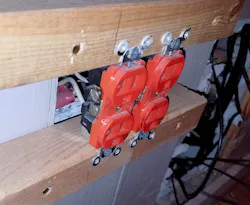
Section 406.5 requires receptacles to be mounted in identified boxes or assemblies. Attaching receptacles to a couple of wooden blocks does not meet Code minimum requirements. It appears these boards were being used as some type of “box extender.” A listed extension ring or listed box extender should have been secured to the flush-mounted box instead. The exposed energized terminals create a shock hazard and violate the rules of Sec. 406.5(I), which requires receptacles to be enclosed so that no live terminals are exposed to contact. The lack of a box cover for the outlet box is a violation of Sec. 314.25. According to Brandon, an equipment grounding conductor (EGC) run separately from the circuit conductors was connected to these isolated ground receptacles. This violates Sec. 250.146(D) and Sec. 300.3(B) if the EGC was not run with the circuit conductors.
About the Author
 Russ LeBlanc
Russ LeBlanc
Owner
Russ started in the electrical trade as an apprentice in 1985. He worked his way up to become a Journeyman Electrician and then eventually became a Master Electrician and Licensed Construction Supervisor. In 1999 Russ become an Electrical Instructor for The Peterson School of Engineering in Massachusetts where he developed his passion for teaching, and quickly became Department Head of Electrical Instruction. Russ has taught thousands of apprentices, electricians, engineers, inspectors, and other electrical professionals during his career as an instructor. He continues to provide electrical professionals with Electrical Code seminars, Arc-Flash Awareness training seminars and educational material through his LeBlanc Consulting Services in North Reading, MA whose specialty is educating electricians. He has been an active member of the NFPA Electrical Section and has authored hundreds of National Electrical Code proposals and comments which have become Code rules to improve the safety for the electrical industry. Russ is also an IAEI certified Electrical Inspector.
Please visit www.russleblanc.net for more information.