Illustrated Catastrophes: Curious Choice of Covers
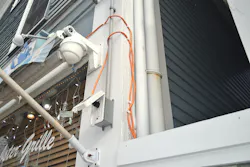
Curious Choice of Covers
The type of cover installed on this exterior receptacle was an inappropriate choice by the installer. For 15A and 20A, 125V and 250V receptacles installed in wet locations, Sec. 406.9(B)(1) requires an enclosure that is “weatherproof whether or not the attachment plug cap is inserted.” This cover is obviously not weatherproof right now. This open cover will allow moisture and rain to damage the GFCI receptacle and other components of this circuit. The use of a deeper cover could solve this problem. These types of receptacles are also required to be listed and identified as being weather-resistant where installed in wet locations. Securing that orange extension cord to the building structure was not a good idea either. Doing so created a violation of Sec. 400.12(4). Flexible cords, flexible cables, cord sets (extension cords), and power supply cords are not permitted to be attached to building surfaces. I suppose one could make the argument that Sec. 590.4(J) may permit extension cords to be supported in this manner for temporary installations. The one bit of good news here is the PVC conduit used to wire this receptacle seems to be installed in compliance with Art. 352.
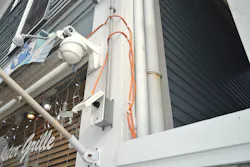
Shocking Find at Marina
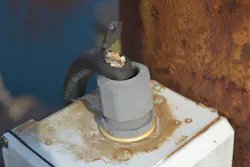
I spotted this damaged cord on a recent visit to a local marina. The damage is so severe that the copper conductors are now exposed, which creates a tremendous shock hazard. This cord was used to provide power to a motorized hoist on a pier. Section 555.34(A)(2) permits the use of extra-hard usage portable power cables as permanent wiring on the underside of piers and where flexibility is necessary as on floating piers. However, Sec. 555.34(A)(4) requires the use of rigid metal conduit (RMC), reinforced thermosetting resin conduit (RTRC), or rigid polyvinyl chloride (PVC) conduit to protect wiring above decks of piers and landing stages and below any enclosures it serves. Perhaps using one of those conduits would have been a better choice of wiring methods here. Section 610.11(E) allows suitable cords to be used for wiring of moving parts of hoists if strain relief and protection from physical damage are provided. Section 400.12(7) similarly prohibits using flexible cords, flexible cables, cord sets, and power supply cords where subject to physical damage. Clearly, this cord has been exposed to physical damage and probably should not have been used here. This installation needs immediate repairs to prevent any injuries (or worse) from happening.
About the Author
 Russ LeBlanc
Owner
Russ started in the electrical trade as an apprentice in 1985. He worked his way up to become a Journeyman Electrician and then eventually became a Master Electrician and Licensed Construction Supervisor. In 1999 Russ become an Electrical Instructor for The Peterson School of Engineering in Massachusetts where he developed his passion for teaching, and quickly became Department Head of Electrical Instruction. Russ has taught thousands of apprentices, electricians, engineers, inspectors, and other electrical professionals during his career as an instructor. He continues to provide electrical professionals with Electrical Code seminars, Arc-Flash Awareness training seminars and educational material through his LeBlanc Consulting Services in North Reading, MA whose specialty is educating electricians. He has been an active member of the NFPA Electrical Section and has authored hundreds of National Electrical Code proposals and comments which have become Code rules to improve the safety for the electrical industry. Russ is also an IAEI certified Electrical Inspector.
Please visit www.russleblanc.net for more information.