Preventing OSHA Citations for the Control of Hazardous Energy, Part 7

Do you know OSHA’s general requirements for training and communication in the control of hazardous energy?

Key Takeaways

  • Train authorized employees to safely apply, use, and remove energy controls; instruct affected and other employees on relevant procedures and restrictions.
  • Explain that tags are warnings, not locks, and must be legible, understandable, suitable for the environment, and securely attached.
  • Retrain employees after assignment changes, when scheduled, or when there is reason to believe retraining is needed; restore proficiency and cover revised procedures.
  • Certify completed, current training by recording each trained employee’s name and training date.
  • Only authorized employees may perform lockout/tagout, and affected employees must be notified before devices are applied or removed.

OSHA provides the requirements for the control of hazardous energy in 29CFR.1910.147. The general requirements [1910.147(c)] are extensive. Let’s look at the requirements that pertain to training and communication in the control of hazardous energy. This text consists of requirements for lockout, tagout, retraining, and certification (i, ii, iii, and iv respectively).

For lockout, the employer must provide training to ensure that employees understand the purpose and function of the energy control program, and those employees have the knowledge and skills to safely apply, use, and remove energy controls. And it’s not just each authorized employee (the ones placing the protection in place), but each affected employee (they have to know the purpose and use of the energy control procedure) and all other employees whose operations may be in the area where energy controls are used (they must be instructed about the program and the prohibition of interfering with or removing energy controls).

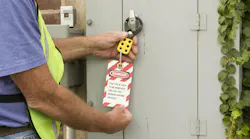
For tags, employees must be instructed in the limitations of tags and in what their responsibilities are toward tags. If attached to an energy isolation means, a tag cannot be removed without the authorization of the person who put it there. Tags also:

  • Are essentially warning signs, they don’t do what a lock does.
  • Must be legible and understandable to anyone who might need to read them.
  • Must be suitable for their environment.
  • May evoke a false sense of security.
  • Must be securely attached to an energy isolation device.

Retraining:

  • Must be provided to employees who have a change of assignment.
  • Shall be conducted per the periodic schedule established in the safety program or when an employer has reason to believe a particular employee needs it.
  • Shall reestablish proficiency, and introduce any new or revised control procedures.

Finally, the employer must certify that the training is completed and up to date. The certification must include the name of each employee trained and the date of the training.

The general requirements end with these:

  • Only authorized employees shall perform lockout/tagout [1910.147(c)(8)].
  • The authorized employees or the employer shall notify the affected employees of the application of lockout devices before they are applied and notify the affected employees of the removal of those devices before they are removed [1910.147(c)(9)].


About the Author

Mark Lamendola

Mark Lamendola

Mark is an expert in maintenance management, having racked up an impressive track record during his time working in the field. He also has extensive knowledge of, and practical expertise with, the National Electrical Code (NEC). Through his consulting business, he provides articles and training materials on electrical topics, specializing in making difficult subjects easy to understand and focusing on the practical aspects of electrical work.

Prior to starting his own business, Mark served as the Technical Editor on EC&M for six years, worked three years in nuclear maintenance, six years as a contract project engineer/project manager, three years as a systems engineer, and three years in plant maintenance management.

Mark earned an AAS degree from Rock Valley College, a BSEET from Columbia Pacific University, and an MBA from Lake Erie College. He’s also completed several related certifications over the years and even was formerly licensed as a Master Electrician. He is a Senior Member of the IEEE and past Chairman of the Kansas City Chapters of both the IEEE and the IEEE Computer Society. Mark also served as the program director for, a board member of, and webmaster of, the Midwest Chapter of the 7x24 Exchange. He has also held memberships with the following organizations: NETA, NFPA, International Association of Webmasters, and Institute of Certified Professional Managers.

Sign up for our eNewsletters
Get the latest news and updates

Voice Your Opinion!

To join the conversation, and become an exclusive member of EC&M, create an account today!