What's Wrong Here? Hint: 1, 2, 3, 4
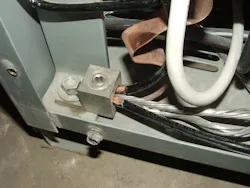
How well do you know the Code? Think you can spot violations the original installer either ignored or couldn’t identify? Here's your chance to moonlight as an electrical inspector and second-guess someone else's work from the safety of your living room or office. Can you identify the specific Code violation(s) in this photo? Note: Submitted comments must include specific references from the 2020 NEC.
Hint: 1, 2, 3, 4
Tell Them What They've Won…
Using the 2020 NEC, correctly identify the Code violation(s) in this month's photo — in 200 words or less — and you could win an Arlington Industries SL1B18 SLIDER BAR kit, which includes a stainless steel trap door cover and a 20A decorator-style, tamper-resistant receptacle. E-mail your response, including your name and mailing address, to [email protected], and Russ will select three winners (excluding manufacturers and prior winners) at random from the correct submissions. Note that submissions without an address will not be eligible to win.
May Winners
Congratulations to our three winners this month: Jennifer Hess, journeyman meter technician for the City of Glenwood Springs, Colo.; Brian Cohen, owner of Bryden Electrical, Inc. in Los Angeles; and Bill Nichols, a building, electrical, and plumbing inspector for the City of Manitowoc, Wis. They were all able to correctly cite some of the Code violations seen in this photo.
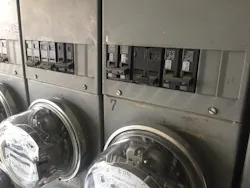
I think the most obvious problem is the fact that the circuit breakers are installed in a position where the ON position of the handle is in the “down” position, contrary to the requirements of Sec. 240.81. Vertically operated circuit breakers must be installed so the “up” position of the handle puts the circuit breaker into the ON position. Upside-down circuit breakers could pose a real safety hazard if a worker mistakenly flips the breaker “down” thinking that he or she is turning the power off when the person is actually turning the power on. Another problem is the lack of labeling of each circuit breaker to indicate what it serves. Section 408.4(A) requires that every circuit be legibly marked to indicate its specific purpose or use. Similarly, Sec. 110.22(A) requires each disconnecting means to be legibly marked to indicate its purpose. Your guess is as good as mine as to what these breakers serve.