Navigating Construction Growth in 2027 Amid Economic Uncertainty
Key Takeaways
- Construction growth in 2027 is expected to be cautious due to rising interest rates, inflation, and geopolitical supply chain issues.
- Data centers and office sectors are projected to continue growing, serving as key drivers amid broader economic uncertainties.
- Labor shortages, financing difficulties, and project cancellations remain significant challenges for construction firms in the near term.
- Long-term prospects remain optimistic, with FMI projecting a steady increase in construction output over the next four years.
- Industry stakeholders should focus on patience, backlog management, and adapting to evolving demand factors to navigate the uncertain landscape.
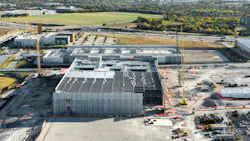
Much as the stock market must routinely scale a wall of worry as it plows ahead over time, the U.S. construction economy will likely grow in 2027 while navigating a slate of troubles.
As 2026 winds down, construction forecasts for the year’s final quarter, 2027, and a few years hence are coming into sharper focus. The emerging consensus appears to be one of rising caution for 2027 growth prospects based on evidence of late-2026 deceleration coupled with optimism for a multi-year rebound starting in 2028.
The immediate concern is a host of issues that could seep into construction demand factors in 2027. That wall of worry the industry faces may be getting steeper and more slippery as interest rates rise, geopolitical issues continue to complicate supply chains and energy availability, inflation persists, and consumer confidence wanes.
Connecting the broader economic backdrop to the construction economy, Anirban Basu, chief economist for Associated Builders and Contractors (ABC), noted in a recent construction outlook webinar, that “with the consumer sentiment index, we’ve never seen it this low. People are in a foul mood and there’s a lot of unhappiness out there. At the heart of that is high and rising prices.”
The consumer’s experience gets the headline attention, but below the surface, the growing economic pessimism and possible pullback on spending could usher in recession-like conditions that would surely take a toll on construction — and that may already be in motion.
“Dodge construction data is showing a sharp decline in construction starts,” Basu says. “More are saying that the availability of financing is a big issue. Interest rates are higher and there’s more pessimism.”
Similar sentiment flows through Raleigh, N.C.-based FMI’s most recent quarterly North American engineering and construction outlook. The sector watcher says the construction market “weakened” since its third-quarter report, adding 2.1 percentage points to its estimate for the yearly decline in value of 2026 construction put-in-place. FMI now puts that number at $2.167 trillion, which would be a decline of 3.4% over what it termed a “flat” 2025.
Census data, the FMI report states, “shows monthly spending running below year-ago levels through the summer. The (19-contruction) segment count now runs four growing, five stable and ten declining, compared with three growing and eight stable last quarter.”
The prediction of a down 2026 stems from broader economic trends. FMI cites slow economic growth, above-target inflation, higher interest rates for longer as macro trends that will affect construction. In spite of stellar growth in some sectors, notably datacenters, it says private non-residential construction spending “sits at its lowest level since early 2023.”
The wild card in some of the predictions could be those data centers. Both ABC and FMI projections are bullish on continued data center construction growth, seeing it as more immune to larger economic forces and a possible counterweight to pullbacks in other sectors.
“The data center buildout is masking overall economic weakness, and that’s even more prominent in the construction sector,” says Basu.
That buildout is facing more uncertainty from talk of data center moratoriums, he adds, but it’s likely most projects on the drawing board will eventually break ground because critical need will prevail over the angst.
“A lot of the pushback I think is mere chatter,” he says. “Approvals make take longer and be more difficult, but in the end enough communities will be willing to say ‘yes’ to them.”
FMI says the office sector, which data centers are a large part of in U.S. construction census figures it cites, is the only one showing continuous growth through 2030.
Its report says “data center construction drives the office gain, with the Census data center line running at a $75 billion annual pace in July, about 50% above 2025 levels. Office holds the steepest five-year growth in the forecast, with power close behind.”
For construction contractors and engineering firms possibly facing a rocky 2027 when it comes to new projects entering the pipeline, the remedy may amount to a blend of patience, persistence, and backlog.
Firms face a number of challenges in a current environment “where fewer projects are viable under the economic circumstances,” Basu says. Leading a list of top-line challenges in a flash poll of attendees conducted during the webinar were labor, insufficient demand, and financing. The latter two concerns grew slightly in mentions from a similar July survey, while labor fell.
The FMI report homed in on the construction labor challenge and project disruptions. Labor, it says “remains the persistent constraint even as demand cools within the private segments,” with an Associated General Contractors survey finding “87% of firms still reporting open craft positions, 29% citing impacts from immigration enforcement, and about half of those active in the data center market seeing wage pressure on skilled trades.” The same survey found more than half of firms reporting non-data-center project cancellations, postponements or scalebacks in the prior six months owing mostly to financing and rising costs.
Looking long term, FMI envisions an eventual construction boom. From a $2.167 trillion estimate for 2026 it sees this four-year progression: $2.179 trillion; $2.282 trillion; $2.430 trillion; and $2.580 trillion. In the short-term, though, there’s a perhaps equal mix of uncertainty and promise clouding the picture.
“The courts are still reviewing the current tariffs, and artificial intelligence adoption keeps reshaping demand across data centers, power, and manufacturing. These risks weigh on growth expectations and add volatility across the industry.”
About the Author
Tom Zind
Freelance Writer
Zind is a freelance writer based in Lee’s Summit, Mo. He can be reached at [email protected].