LEDs Gain Ground in Controlled Environment Agriculture Space
Key Takeaways
- LED lighting has shifted from niche to mainstream in controlled environment agriculture, driven by improved spectrum, output, and cost reductions.
- Energy efficiency of LEDs allows growers to achieve higher light levels with less power, enabling cost savings and increased crop productivity, especially in high-value sectors like cannabis.
- Dynamic spectrum control enhances crop quality and yield by allowing growers to customize light recipes for different growth stages, improving nutritional density and shelf life.
- Utility rebates and incentives significantly offset the higher upfront costs of LEDs, making them a financially attractive option for growers investing in long-term infrastructure.
- LEDs' lower heat output impacts HVAC and humidity management, creating new opportunities for electrical contractors to optimize greenhouse climate control systems.
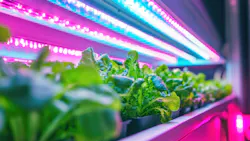
PPE stands for personal protective equipment — unless you’re working in horticulture lighting. Then it’s also short for photosynthetic photon efficacy, which measures the amount of electricity used to generate light that plants can use to grow. And not all light is created equal. Some wavelengths are better than others when it comes to optimizing a crop’s maturity, flavor, shelf life, cannabinoid profile, and other characteristics that directly affect the grower’s competitiveness and bottom line.
Those are just a few examples of artificial lighting’s role in controlled environment agriculture (CEA) facilities, which include greenhouses, warehouses, vertical farms, and even caves. The CEA market will grow from nearly $10 billion this year to $27.7 billion by 2035, Business Research Insights estimates.
LED lighting is helping enable that growth. For years, it struggled to get a toehold in CEA, which was dominated by technologies such as high-intensity discharge (HID). That’s changed.
“The technology and cost for LEDs was not there in terms of ROI for most growers,” says Jud McCall, Hydrofarm Commercial CEA food and floral director. “The promise was, but the output, spectrum, and cost per unit were just not practical. This kind of reached an inflection point in 2020 to 2021. Up to that point, we were selling [about] 80% HID, but then it just flipped in the space of maybe 12 to 16 months to 80% LED. This happened due to lower cost along with better quality, spectrum, and output on newer LEDs.”
That trend continues.
“In 2024, total lighting sales based on our own market characterization was about 60% LED, which I think is a big indicator that the industry is coming along in terms of new facilities being built,” says Kasey Holland, DesignLights Consortium senior technical manager for horticultural lighting. “That being said, in most of the CEA space, the greenhouses and legacy infrastructure are still relying on non-LED technology. LED adoption is not lagging behind anymore, but I would estimate the CEA industry is probably not even 15% LED yet.”
For electrical contractors and design firms, that relatively small installed base means ample opportunities over the next several years to help growers upgrade existing CEA facilities to LED.
“We still do see some high-pressure sodium and HID lights being sold, but that is dropping off quite significantly in the last year or two in favor of LED,” says Chris Bezuyen, who manages Signify’s North America team of application engineers for the traditional horticulture and cannabis markets.
More light for less money
One major and obvious reason for LED adoption is energy efficiency.
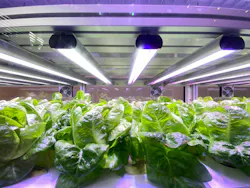
“They’re selecting LED instead of HID or HPS because they can achieve higher light levels for the same electrical energy input,” Bezuyen says. “Generally, they can achieve 30% to 40% higher light levels watt for watt.”
Efficiency doesn’t just save money. It can also help make money by enabling each watt to feed more plants.
“Leveraging more energy efficient technology can actually allow them to scale without using more energy,” Holland says. “That's definitely a big value prop for energy-efficient technologies.”
LEDs still have a price premium compared to traditional horticulture lighting technologies. But that upfront cost is something growers know, unlike the wild card of electric rates three or five years from now, especially if hyperscale data centers sprout up nearby.
“We can fairly easily demonstrate a rapid ROI, especially with the ever-increasing energy costs,” Bezuyen says. “That ROI becomes more and more attractive every quarter.”
Utilities also see value in LED, which is why they incentivize them.
“With rising energy costs, the 40% to 60% energy savings of LEDs are vital,” says Kassim Tremblay, Sollum senior VP of sales. “Many U.S. utility providers offer significant rebates for shifting to energy-efficient horticultural lighting, which helps offset capital expenditure [for growers].”
Many utilities use the DLC’s horticultural lighting Qualified Products List (QPL) when reviewing rebate submissions.
“We have a lot of different thresholds, and we make sure manufacturers demonstrate compliance with those,” Holland says. “That's really what gives utilities confidence that the QPL products are meeting that bare minimum and worth incentivizing. The value of these utility rebates is quite drastic, depending on how large the project is. I've heard they often exceed $150,000 per project into the millions.”
Longevity also helps offset the price premium.
“LED’s with an L90 or Q90 of 50,000 hours means that they will still have 90% of their output for 10+ years of 12-hour-a-day operation ,” McCall says. “Traditional single-ended and double-ended HID systems, whether HPS or MH, require that lamps be replaced every year or two based on hours of operation to maintain optimal spectrum and output. Combining lamp replacements and added electrical cost of HID systems, a grower can end up paying more for HID lighting versus LED lighting over the long term.”
Crop type and geography affect adoption
Crop type and geography are two additional factors.
“Perhaps, you’re a bedding plant grower in Oklahoma and just need supplemental lighting for an early start for your bedding plant crops in January/February,” McCall says. “There could be an ROI advantage to using HIDs versus paying twice as much for LEDs that you're not going to use for 10 months of the year. However, if you are a greenhouse tomato grower in Michigan, you will need more supplemental light for more months of the year, and the added electricity and required HID lamp replacements quickly erode any perceived savings HIDs might appear to offer. Also, LEDs offer more optimal PAR spectrum versus HID. We are at the point for most growers where LED is the preferred choice, and HID lighting options are disappearing from the market increasingly as demand for the older tech continues to decline. ”
The cannabis legalization trend is helping drive the LED market.
“Adoption of LEDs is much higher for cannabis growers because it's a cash crop,” Holland says. “Food producers and floriculture (and various other kind of sectors within CEA) are still seeing growth in terms of LED adoption. But if they don't have the same kind of profit margins, they're not necessarily as eager about doing it unless there are other kind of business factors.”
One of those factors is location.
“I've got a couple of customers in British Columbia where, due to the mountain ranges and where they are on the latitude of the Earth, they generally have dark winters and cloudy weather,” Bezuyen says. “They've done a phenomenal job of implementing these lighting strategies. Then, as we get further south, we've got greenhouses that use it for just a few months a year to extend their day in in the dark months of the winter.”
Controlled growth
Another business driver for LEDs is their ability to support dynamic spectrum, which can improve quantity and quality.
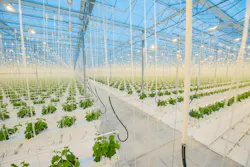
“That has been a real hot topic the last year or two,” Bezuyen says. “Growers want independent control of red, green, blue, and far-red bands of light spectrum. Dynamic spectrum control allows them to dial in an optimal light spectrum recipe for the various crop phases.”
This capability carries a premium.
“The cost of adopting luminaires capable of dynamic spectrum generally is 15% to 20% higher than conventional LED where it's a static spectrum,” Bezuyen says.
The payoff is more and better products.
“Dynamic lighting allows for ‘light recipes’ that can increase yields,” Tremblay says. “We’ve seen up to 20% increases in tomatoes. [It also helps] improve the shelf life and nutritional density of produce.”
Greenhouses use sunlight, whose quantity and quality varies significantly based on the weather and season. Dynamic spectrum control enables growers to supplement natural light with LEDs.
“It really allows them to fine tune the productivity of their cultivation operation,” Bezuyen says. “It allows them to dial in precisely what the plant needs and wants to draw out certain characteristics. They can improve plant health and quality for fruits and vegetables. In the middle of the day, they can optimize their lighting spectrum to the very high efficacy pure red. Then when the sun starts to set, they can deliver to the plant what the sun is not giving during that time.”
Fruit and vegetable producers are the biggest users so far.
“The cannabis market, I think, is only now discovering what they can do with dynamic spectrum to increase certain THC profiles or flavor profiles or cannabinoids,” Bezuyen says.
LED creates HVAC opportunities
LED’s impact on utility costs isn’t limited to lighting.
“In northern U.S. climates, HPS lamps traditionally provided ‘free’ radiant heat,” Tremblay says. “When switching to LEDs, growers must rethink their HVAC and greenhouse heating strategies, as LEDs run much cooler.”
This change can create opportunities for electrical contractors that also provide commercial and industrial HVAC services.
“It's not always just about managing heat load, but also about managing the dehumidification of the facility,” Bezuyen says. “HID and HPS luminaires have a higher percentage of radiant heat in comparison to LED, so growers need to manage humidity in a different way than they did with HID and HPS.”
Control systems are critical for coordinating HVAC, fans, irrigation, and heaters and automating supplemental lighting for all types of CEA growing.
“Our LEDs, like many others, offer dimmable output, and they can adjust in real time with the right control system,” McCall says. “The PAR sensors and controller say: ‘The clouds just rolled in. Time to turn the lights on. We don't need them at 100% output. Let's run them at 30% to keep desired light level constant for the day.’ Some growers use that cultivation approach where lighting consistency is paramount. Other growers might just run their lights X number of hours a day at 100% output to insure their crop is meeting optimal DLI requirements in the winter months for their region. Let's say you have a greenhouse in Ohio. In December you might need to run them all day, most days, given the average DLI requirement for many crops.”
Full control system capabilities are coming down in price for smaller greenhouses.
“A full greenhouse controller historically is an expensive proposition, but it can control and automate lighting and many things for a large, multiple-bay greenhouse operation,” McCall says. “However, for smaller greenhouse growers, the price for this degree of control was not always practical. That has changed.”
Generators and cogeneration
Growers rarely use solar to augment their grid supply, such as in places where rates vary by time of day. That’s mainly because it would take an enormous array to generate enough power.
Instead, some use cogeneration systems, which generate heat as a useful byproduct.
“They're using natural gas to run a generator, and they’re using the carbon dioxide byproduct and sending it through the greenhouse,” Bezuyen says. “They don't just blow off the heat into the atmosphere. They also do heat buffering where during the day they warm up giant storage tanks and then reuse that heat through the evening as they try to level load.”
Cogen adoption varies somewhat by location and fuel prices.
“Cogen used to be a lot more attractive because natural gas was so cheap,” Bezuyen says. “I'm seeing that starting to level off a little bit in North America. I'm seeing fewer and fewer cogens being installed.”
Some CEA facilities use diesel generators. Like cogen, these systems are yet another opportunity for electrical firms.
“Typically those are greenhouses where they just cannot get the electrical energy from the grid because the infrastructure just there yet,” Bezuyen says. “It's actually fairly cheap for them to run those generators.”
About the Author
Tim Kridel
Freelance Writer
Kridel is an independent analyst and freelance writer with experience in covering technology, telecommunications, and more. He can be reached at [email protected].