This Drives Me Plumb Crazy
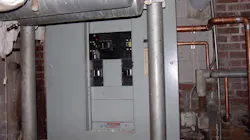
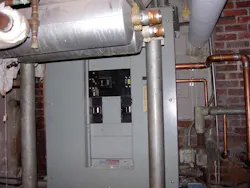
As you can see by this photo, plumbers and electricians are still waging a never-ending battle for space. I don’t know who was here first, but the result is an installation with no clear working space as required by Sec. 110.26(A). For equipment such as switchboards, panelboards, and other equipment likely to be examined, adjusted, serviced, or maintained while energized, Sec. 110.26(A)(1) requires a minimum working space depth ranging from 3 ft to 5 ft, depending on conditions and voltage. The minimum width of the working space required by Sec. 110.26(A)(2) is 30 in., or the width of the equipment, whichever is greater. The minimum height required by Sec. 110.26(A)(3) for the working space extends from the floor, grade, or platform to a height of 6½ ft or the height of the equipment, whichever is greater. Working in crowded and cramped conditions such as this greatly increases the danger of the already hazardous job of working on energized electrical equipment. Building owners and managers need to recognize this threat and coordinate with all the building trades in an effort to prevent situations such as this from arising on their property.
Missing Cover Mystery
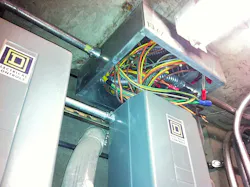
I spotted this messy junction box in a parking garage. Where is the cover? I didn’t see it anywhere. Was it ever even installed? It is all a great mystery as to what became of this cover. Leaving a junction box open with energized 480V circuit wiring dangling out of it creates an elevated shock hazard for anyone working near or accidently contacting these wires. Section 314.25 requires boxes to be fitted with a cover, canopy, faceplate, lampholder, or luminaire for a completed installation. Another item for discussion is the flexible metal conduit (FMC) that is running through the inside of the box. Is this a violation? There is nothing in the Code that specifically prohibits this practice. In fact, Sec. 725.136(C) permits raceways containing Class 2 or Class 3 circuits to be installed inside of enclosures as a means to separate the Class 2 or Class 3 circuits from any Class 1, non-power-limited fire alarm circuits, and medium-powered broadband communications circuits. Section 760.136(C) permits the same application for power-limited fire alarm circuits. I’m not sure what type of wiring was installed inside this FMC, but this certainly makes for a good discussion to have with the AHJ.
About the Author
 Russ LeBlanc
Russ LeBlanc
Owner
Russ started in the electrical trade as an apprentice in 1985. He worked his way up to become a Journeyman Electrician and then eventually became a Master Electrician and Licensed Construction Supervisor. In 1999 Russ become an Electrical Instructor for The Peterson School of Engineering in Massachusetts where he developed his passion for teaching, and quickly became Department Head of Electrical Instruction. Russ has taught thousands of apprentices, electricians, engineers, inspectors, and other electrical professionals during his career as an instructor. He continues to provide electrical professionals with Electrical Code seminars, Arc-Flash Awareness training seminars and educational material through his LeBlanc Consulting Services in North Reading, MA whose specialty is educating electricians. He has been an active member of the NFPA Electrical Section and has authored hundreds of National Electrical Code proposals and comments which have become Code rules to improve the safety for the electrical industry. Russ is also an IAEI certified Electrical Inspector.
Please visit www.russleblanc.net for more information.