What Is Harmonic Magnitude?
Key Takeaways
- Harmonic magnitude indicates the amplitude of specific harmonic frequencies within a distorted electrical waveform.
- Harmonic spectra visually display the size of each harmonic component, helping identify sources of power quality issues.
- Different load types produce characteristic harmonic patterns, such as dominant 3rd harmonics or paired harmonics, aiding in equipment diagnosis.

Harmonic magnitude is the amplitude or strength of a specific higher-frequency waveform component — known as a harmonic — contained within a distorted electrical waveform.
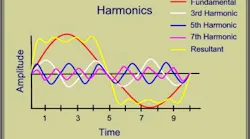
In a clean alternating current (AC) system, current and voltage follow a smooth, linear sinusoidal path at a base fundamental frequency (such as 60 Hz). However, modern non-linear loads like computers, LED drivers, and variable-frequency drives draw power in abrupt pulses or in other non-linear ways rather than continuous curves. Using mathematical tools like Fourier analysis, power quality engineers can decompose these complex, distorted waveforms into the fundamental frequency, direct current (DC) portion, plus a series of integer-multiple harmonic frequencies. Harmonic magnitude defines exactly how large or powerful each individual frequency component is.
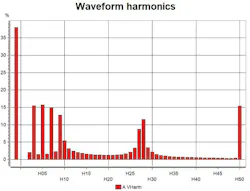
When analyzed across a system, individual magnitudes are displayed on a harmonic spectrum — a bar graph or table showing the voltage or current strength at each harmonic frequency. These relative sizes serve as an essential diagnostic tool, offering direct clues about the equipment causing the distortion. For example, a spectrum showing a dominant 3rd harmonic followed by decreasing 5th and 7th harmonics may point to single-phase switching power supplies found in office IT equipment. Conversely, a pattern dominated by pairs — the 5th and 7th, 11th and 13th, and 17th and 19th — indicates a 3-phase, 6-pulse rectifier common in industrial motor drives.
Power instruments express harmonic magnitude either in absolute units matching the base signal (amperes for current, volts for voltage) or as a percentage relative to the fundamental waveform's size. While individual magnitudes identify specific load behaviors, they are also combined to calculate total harmonic distortion (THD), providing a single value that represents the overall impurity of the electrical signal.
About the Author
 Ross Ignall
Ross Ignall is the Director of Business Development and Marketing at Dranetz Technologies, a GMC Instruments company, where he has more than two decades of experience in power monitoring and analysis. With a background in engineering and product management and a career focused on instrumentation, power quality and energy solutions, Ross has been instrumental in building the GMC Instruments brand Dranetz. He works closely with engineers, utilities, and facility teams to align technology with real-world needs. A published author, IEEE and IEC committee member, and speaker in the fields of instrumentation, power quality, and demand/energy, he is a trusted resource in helping organizations take a smarter, data-driven approach to power system reliability. Ross can be reached at [email protected].