25 Years of NEC Changes Through My Eyes
Key Takeaways
- Expansion of AFCI and GFCI protections has transformed residential wiring practices and increased safety awareness.
- Introduction of arc flash warning labels and energy reduction requirements shifted focus toward personnel safety during faults.
- Changes to grounding electrode requirements and fault current considerations have impacted construction and inspection processes.
- Revisions in feeder and multiwire branch circuit practices have altered standard wiring methods across the industry.
- Relocation of dwelling service disconnects outdoors enhances safety for emergency responders and influences entire electrical system design.

When EC&M asked me to look back over the last 25 years and identify some of the most significant changes to the National Electrical Code (NEC), I thought it would be an easy assignment. After all, every three years we get another edition of the NEC filled with revisions, additions, deletions, new technologies, and plenty of things for electricians and inspectors to debate. But the more I thought about it, the harder the assignment became — because not every change that creates discussion when it first appears ends up having a lasting impact on the industry. Some changes become routine almost immediately, while others force us to rethink the way we design, install, inspect, and even understand an electrical system.
I have been fortunate to experience many of these changes from several different perspectives. I worked in the field as an electrician in Virginia and Texas, and later in my career I served as an electrical inspector, plans examiner, and electrical engineer II for larger jurisdictions. That means I have stood on both sides of the counter. I have been the electrician looking at a new Code requirement and wondering why we suddenly could not do something the way we had done it for years. I’ve also been the person reviewing plans or inspecting installations and explaining those same kinds of changes to contractors, engineers, electricians, and owners. Looking back through those eyes, several changes stand out to me because they did more than modify a Code section; they changed the way our industry actually works.
Expansion of AFCI protection
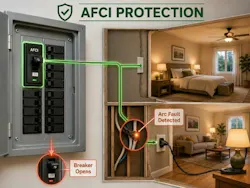
One of the first that comes to mind is arc-fault circuit interrupter (AFCI) protection (Photo 1). The original bedroom requirement came from the 1999 NEC with an effective date of Jan. 1, 2002, and from there AFCI protection began a steady expansion through dwelling-unit branch circuits. The 2008 NEC pushed the requirement into many more areas of the home, and the 2014 NEC expanded it even further. I remember when most electricians thought of AFCIs as “those bedroom breakers.” That didn’t last very long. As the requirements expanded, panel layouts changed, multiwire branch circuits became more complicated, troubleshooting practices changed, and electricians became much more aware of wiring conditions that a conventional circuit breaker might never have revealed. Whether you agreed with every expansion or not, AFCI protection fundamentally changed residential electrical work.
Expansion of GFCI protection
Ground-fault circuit interrupter (GFCI) protection followed a different path, but its impact has been just as significant. GFCIs existed long before the 25-year period we are looking at, but what happened to Sec. 210.8 during that time is remarkable. What many of us once viewed as protection for a fairly predictable group of receptacles in bathrooms, garages, kitchens, outdoors, and similar locations continued expanding into additional locations, voltages, outlets, appliances, and equipment. By the 2023 NEC, the requirements had grown well beyond the simple rules many electricians learned earlier in their careers, and the 2026 NEC continues that philosophy. From an inspection standpoint, GFCI protection is no longer something you evaluate by simply asking whether a receptacle is near a sink. You have to understand the location, voltage, equipment being supplied, occupancy, and actual application. That evolution alone tells you how dramatically the NEC’s approach to shock protection has changed.
Arc flash warning and arc-energy reduction
Another major shift began with the 2002 NEC and Sec. 110.16, when arc flash warning requirements entered the Code. I believe that change represented something larger than a labeling requirement. For years, our industry had focused heavily on shock hazards, overcurrent protection, conductor ampacity, and equipment damage. Arc flash awareness forced us to think more directly about the person standing in front of energized equipment during an arcing event. Later Code cycles carried that concept further through the arc-energy-reduction requirements of Secs. 240.87 and 240.67. Suddenly, the question was not simply whether an overcurrent protective device would clear a fault, but how quickly it would clear it — and how much energy could be released before it did. For commercial and industrial electrical systems, that was a major change in the way we looked at protection.
Concrete-encased electrode requirements
The 2005 NEC brought another change that may not have received the same attention at the time, but it had a tremendous impact on new construction. Changes to Sec. 250.50 made the concrete-encased electrode, what most electricians simply call the “Ufer,” something that could no longer be casually overlooked when one was present. From the inspection side, this was especially interesting because by the time the electrical contractor showed up, the footing might already be poured. If nobody thought about the concrete-encased electrode before the concrete truck left, the problem had already been created. One change in the NEC suddenly required electricians, general contractors, concrete contractors, designers, and inspectors to start thinking about the grounding electrode system much earlier in the construction process. That is the kind of change that reaches far beyond the wording of the Code itself.
SCCR and available fault current
That same general period also forced the industry to pay much closer attention to short-circuit current ratings and available fault current. The 2005 NEC introduced Art. 409 for industrial control panels, helping move SCCR into the mainstream discussion, and the 2011 NEC added Sec. 110.24, requiring available fault current marking at service equipment in other than dwelling units. As a plans examiner, this became especially important to me because the ampere rating of a service tells only part of the story. A drawing might show a 1,200A service, but that does not tell me whether the equipment is actually suitable for the system. What is the available fault current? What is the interrupting rating of the protective device? What is the short-circuit current rating of the equipment? Those are questions that became increasingly difficult for our industry to ignore — and for good reason.
Selective coordination requirements
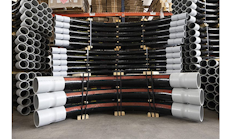
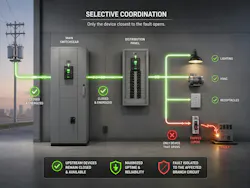
Selective coordination also deserves a place among the most significant changes of this period (Photo 2). Beginning with important requirements in the 2005 NEC and evolving in later editions, emergency and other critical systems forced designers and inspectors to look beyond whether an individual breaker or fuse was properly sized. We had to understand what would happen throughout the distribution system when a fault occurred. Would the device closest to the fault operate, or would an upstream device unnecessarily remove power from other portions of an emergency system? From the plans-review side of the counter, that could turn what looked like a fairly simple one-line diagram into a much deeper discussion involving time-current curves, breaker settings, fuse selections, available fault current, and overall system coordination.
Feeders to separate buildings
Then came the 2008 NEC, and electricians who were around before that edition will probably remember at least two changes very clearly. One involved feeders to separate buildings. For years, under specific conditions, electricians could use the grounded conductor as part of the grounding and bonding arrangement at a detached structure.
The 2008 NEC changed the normal method for new installations by generally requiring an equipment grounding conductor to be run with the feeder conductors while keeping the grounded conductor isolated at the separate building. I installed systems when the older method was permitted, and later I inspected systems where that same method was no longer acceptable for new work. Those are the changes you remember because they replace practices you personally performed for years.
Multiwire branch-circuit disconnecting requirements
The other major 2008 change involved multiwire branch circuits. Electricians had commonly supplied them from individual single-pole breakers, but Sec. 210.4(B) changed that practice by requiring simultaneous disconnecting of the ungrounded conductors at the point where the branch circuit originates. Today, reaching for a common-trip breaker or identified handle tie seems completely normal, but it did not seem nearly as normal when electricians had been doing it another way for generations. It’s a good example of how a short requirement can change a very familiar installation practice across residential, commercial, and industrial work.
Grounded conductors at switch locations
The 2011 NEC brought another change that every electrician who remembers the traditional switch loop can appreciate. Section 404.2(C) began requiring the grounded conductor at many lighting switch locations. For decades, electricians routinely dropped a 2-wire cable to a switch and never gave the absence of a neutral a second thought. Then came electronic switches, occupancy sensors, timers, and eventually smart controls, and the electrical installation had to change with the technology. That one requirement altered a wiring method electricians had used almost automatically for years, and today it is easy to forget how normal the older method once was.
PV rapid shutdown requirements
The 2014 NEC then introduced rapid shutdown requirements in Sec. 690.12 for photovoltaic (PV) systems on buildings, and solar forced us to rethink something electricians had taken for granted for a very long time: Turn off the service disconnect and the building is de-energized. With PV systems, that is not necessarily true. A PV array can continue producing voltage as long as the sun is shining, so rapid shutdown changed equipment and system design because the NEC now had to address energized conductors associated with a source that did not disappear simply because utility power was disconnected. For electricians, inspectors, designers, and emergency responders, that was a significant change in how we viewed electrical safety on buildings.
Dwelling service disconnects move outdoors
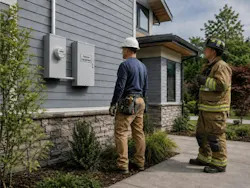
These 10 changes have had enough time for us to see just how much they affected the industry, but I cannot finish this article without recognizing one more, especially in a year when EC&M is celebrating 125 years of serving the electrical industry since 1901. For most of my career, the service disconnect for a house could easily be located inside the dwelling, perhaps just inside the garage, in a basement, utility room, or another permitted location nearest the point of entrance of the service conductors. Then came the 2020 NEC and Sec. 230.85, requiring an emergency disconnect in a readily accessible outdoor location for one- and two-family dwellings (Photo 3). That alone was significant because firefighters and other emergency responders should not have to enter a burning building simply to find a way to disconnect electrical power.
What makes that change even more interesting is that the NEC did not stop there. By the 2026 NEC, the concept evolved again, with the service-disconnect requirements revised so that the service disconnect for one- and two-family dwellings is now located in a readily accessible outdoor location.
Think about that for a moment. A service arrangement that generations of electricians considered completely normal has fundamentally changed in only a few Code cycles. And moving that disconnect outdoors changes far more than where we mount a breaker. It changes where the grounded conductor is bonded, where the equipment grounding conductor begins, how the grounding electrode system is connected, what conductors leave that equipment, and how we think about the entire dwelling service.
Looking back over the last 25 years reminds me that the biggest NEC changes are not always the ones that take up the most space in the Code. Sometimes, a few sentences can change a wiring method electricians have used for generations. Sometimes, a new requirement changes how an entire distribution system is designed. Other times, it changes the way we think about a hazard altogether.
I have watched many of these changes first through the eyes of an electrician and later through the eyes of an inspector and plans examiner. If that experience has taught me anything, it is that the systems change, the technology changes, and the NEC changes right along with them. And if we intend to remain qualified electrical professionals, we have to be willing to change with them.
About the Author
 Paul Abernathy
Paul Abernathy is the Director of Technical Services at Prysmian, and the CEO, president, and chairman of Electrical Code Academy, Inc., and serves as executive director and founding member of the Certified Master Electrical Code Professional® (CMECP®) program. Since entering the electrical industry in 1986, Paul has served as a licensed electrician, electrical contractor, electrical inspector, electrical plans examiner, electrical engineer, code consultant, and educator. He has served on NFPA 70 National Electrical Code Code-Making Panels 5 and 17 and has extensive experience in code development, enforcement, and technical education. Paul’s public-sector experience includes serving as Electrical Engineer II for the City of Richmond, Virginia, overseeing electrical inspectors and inspection operations, and as Manager of Codes for the City of Alexandria, Virginia. He also served as a Southern Field Expert for the National Electrical Manufacturers Association (NEMA). Paul previously owned and operated electrical contracting and electrical design/code consulting firms, including Abernathy Electrical Services in McKinney, Texas, which he closed in 2021. Today, he continues to support the electrical industry through technical leadership, NEC education, professional certification, and training for electricians, inspectors, engineers, contractors, and code professionals."