Illustrated Catastrophes: Reach for the Sky
All references are based on the 2020 edition of the NEC.
Reach for the Sky
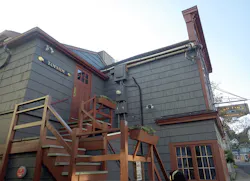
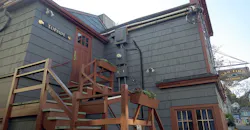
Reaching for the sky is what you would be doing when trying to reach the service disconnecting means mounted at the roofline of this restaurant. There is no way to access this equipment without climbing over a railing or using a portable ladder. Article 100 describes readily accessible as capable of being reached quickly without climbing over obstacles or resorting to portable ladders. Section 230.70(A)(1) requires the service disconnecting means to be installed at a readily accessible location either outside the building or inside the building. There are no exceptions to this rule. The location of this service disconnecting means certainly does not meet the requirements for it to be readily accessible. Perhaps the stairway was configured differently at a previous time, and renovations rendered this disconnect inaccessible. I’m not sure of the history here, but I do know that this situation creates a Code violation today. One more tidbit that may be hard to spot: There are set-screw type couplings installed on the two raceways, leaving the bottom of each enclosure under the meter socket. Installing set-screw type fittings in this outdoor wet location is a violation of Sec. 314.15. Fittings installed in wet locations must be listed for wet locations.
Ode to the Leaning Tower of Pisa
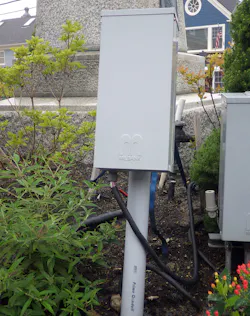
I have had the pleasure of visiting the Leaning Tower of Pisa in Italy and climbing the stairs all the way to the top. Seeing such a magnificent structure withstand the test of time, despite leaning nearly 4° to 5° for centuries was truly impressive. This electrical installation is doing a bad impersonation of that beautiful tower. Relying on PVC conduit to support such a huge enclosure was a big mistake by the installer. Section 352.12(B) prohibits PVC conduit from supporting luminaires or any other equipment, except for conduit bodies of the same size as the PVC conduit itself. The weight of this enclosure is causing the conduit to lean and bend. The conduit may eventually snap if corrective actions are not taken. Another problem I noticed was the flexible cord slipping out of the connector installed on the bottom of the enclosure. I believe the flexible cord is providing power or controls to some irrigation equipment, but I am not 100% sure. However, I am sure the terminations and exposed conductors of the cord are now in danger of being damaged. Section 400.14 requires flexible cords and flexible cables to be connected to fittings in a manner that tension is not transferred to joints or terminals.
About the Author
 Russ LeBlanc
Russ LeBlanc
Owner
Russ started in the electrical trade as an apprentice in 1985. He worked his way up to become a Journeyman Electrician and then eventually became a Master Electrician and Licensed Construction Supervisor. In 1999 Russ become an Electrical Instructor for The Peterson School of Engineering in Massachusetts where he developed his passion for teaching, and quickly became Department Head of Electrical Instruction. Russ has taught thousands of apprentices, electricians, engineers, inspectors, and other electrical professionals during his career as an instructor. He continues to provide electrical professionals with Electrical Code seminars, Arc-Flash Awareness training seminars and educational material through his LeBlanc Consulting Services in North Reading, MA whose specialty is educating electricians. He has been an active member of the NFPA Electrical Section and has authored hundreds of National Electrical Code proposals and comments which have become Code rules to improve the safety for the electrical industry. Russ is also an IAEI certified Electrical Inspector.
Please visit www.russleblanc.net for more information.