Illustrated Catastrophes: An Electrifying Discovery
All references are based on the 2020 edition of the NEC.
An Electrifying Discovery
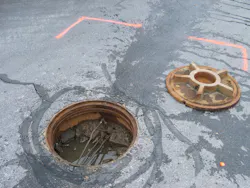
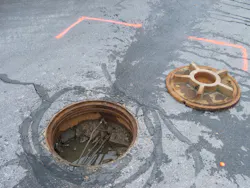
I discovered this dangerous situation while troubleshooting the loss of power to some storage unit buildings. The direct-buried USE feeder conductors were installed way too shallow and damaged during some repair work to the parking lot pavement. Table 300.5(A) sets the minimum cover requirements for direct-buried conductors at 24 in. These are buried a mere 8 in. deep. To fix the damaged conductors, somebody used this metal manhole cover and support ring as a “handhole” for splicing the conductors. Section 314.30 requires handholes to be identified for use in underground systems. Unfortunately, the shoddy splicing repairs on the conductors resulted in failed splices and an energized metal cover. Section 314.30(C) requires splices in handholes to be listed for use in wet locations. This installer used set-screw butt splices and PVC tape for splicing these aluminum conductors. Water eventually caused the splices to fail. The metal cover and supporting ring were not bonded as required by Sec. 250.96(A) and became energized from one of the failed splices. Thankfully, I discovered this problem and made some permanent repairs before an animal or person was injured or killed by this energized cover.
Flagrant Freezer Violation
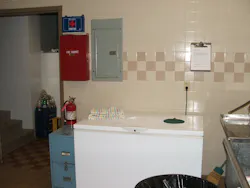
Electricians and other frequent users of the Code can spot this workspace violation from a mile away. Unfortunately, as evidenced all too often by pictures like these, many property owners and business managers don't know the rules. Whoever placed the freezer in this location could not have chosen a worse spot when it comes to providing a safe workplace and Code-compliant installation. Section 110.26 requires access and working space to be provided and maintained for all electrical equipment to allow safe maintenance and operation of the equipment. The minimum required working space depth is set at 3 ft per Sec. 110.26(A)(1). The minimum width is 30 in. per Sec. 110.26(A)(2), and the minimum height per Sec. 110.26(A)(3) is 6½ ft. This space in front of the panelboard must be kept clear and cannot be used for storage as clearly stated in Sec. 110.26(B). OSHA 1910.303(g)(1) requirements for maintaining a safe working space in front of this panelboard are virtually identical to the Code requirements, so even if property owners and business managers are not familiar with the Code rules, they must provide a safe workplace in compliance with OSHA regulations.
About the Author
 Russ LeBlanc
Owner
Russ started in the electrical trade as an apprentice in 1985. He worked his way up to become a Journeyman Electrician and then eventually became a Master Electrician and Licensed Construction Supervisor. In 1999 Russ become an Electrical Instructor for The Peterson School of Engineering in Massachusetts where he developed his passion for teaching, and quickly became Department Head of Electrical Instruction. Russ has taught thousands of apprentices, electricians, engineers, inspectors, and other electrical professionals during his career as an instructor. He continues to provide electrical professionals with Electrical Code seminars, Arc-Flash Awareness training seminars and educational material through his LeBlanc Consulting Services in North Reading, MA whose specialty is educating electricians. He has been an active member of the NFPA Electrical Section and has authored hundreds of National Electrical Code proposals and comments which have become Code rules to improve the safety for the electrical industry. Russ is also an IAEI certified Electrical Inspector.
Please visit www.russleblanc.net for more information.