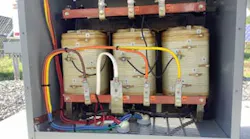
The Most Memorable PQ Articles of 2026
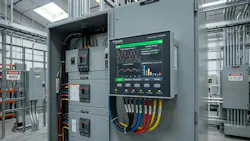
At EC&M, power quality and reliability is always one of our most in-demand topics, helping electrical professionals find the causes of unexplained equipment trips, failures, and downtime. In this year-end roundup, we’ve compiled some of our most memorable power quality coverage from 2026 — from rapid load swings in AI data centers to practical advice on troubleshooting harmonics and getting more out of a power quality survey.

Addressing Power Quality Challenges in AI Data Centers
When 100 AI server racks drawing 100 kW apiece trip offline at once, 10 MW of demand can disappear in an instant. Roosevelt Standifer Jr. with PBE Engineers explains how rapid load swings can destabilize grid voltage and frequency, how cooling-system drives add harmonic distortion, and why data center operators and utilities should share real-time power quality data. Read the full article for tips on how to manage voltage instability, harmonics, and rapid load swings in AI data centers.
Don't Waste Your Power Quality Survey
Before commissioning a power quality survey, fix the electrical problems you can already find. Electrical Consultant Mark Lamendola explains how addressing bonding errors, unbalanced loads, and high-impedance connections upfront helps a full survey, from the utility service to the branch circuits, reveal the harder-to-find causes of equipment failures. Read the full article to learn how to prepare your facility for a comprehensive power quality aurvey by addressing obvious electrical issues first.

Harmonics: What Electrical Contractors Need to Know — Part 1 and Part 2
A neutral conductor can overheat even when phase currents look normal, and harmonics may be the culprit. In this two-part series, Ross Ignall explains how loads like variable-frequency drives and LED lighting can contribute to harmonic distortion. Part 1 explains how nonlinear loads such as variable-frequency drives and LED lighting create harmonics and why the resulting distortion can show up as overheated neutrals, nuisance trips, or failed capacitor banks. Part 2 shows electrical professionals how to look beyond a total harmonic distortion reading, evaluate individual harmonics, and understand where IEEE 519 limits apply. It also explains when to use active or passive filters, line reactors, or phase-shifting transformers.
EC&M On Air Podcast: Power Quality Monitoring With Philip Keebler
What can continuous power quality monitoring reveal about an electrical system? In the final installment of a three-part EC&M On Air interview, Ellen Parson talks with Philip Keebler, technical advisor with PBE Engineers, about establishing a baseline, tracking changes in voltage and current distortion, and uncovering problems such as switching transients and grounding issues. Listen to the podcast.
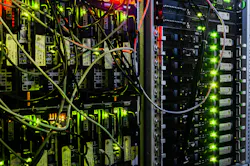
Reducing the Impact of Utility Switching Transients and Ferroresonance in Data Centers
A utility switching event can produce a voltage spike in microseconds, fast enough to upset a data center’s UPS controls. In this piece, Jayakrishna Kasturi, P.E., explains how switching can also trigger ferroresonance, which can sustain voltages at two to four times normal, and how controlled switching, proper grounding, and transient modeling can help reduce the risk.
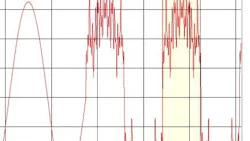
What Is... Power Quality Series
In the first two installments of EC&M’s new What Is series, Ross Ignall of Dranetz explains where harmonic distortion comes from and how to trace it back to the equipment producing it.
- What Is Harmonic Pollution? explains how nonlinear loads such as LED drivers and variable-speed drives distort electrical waveforms and can contribute to overheating, nuisance trips, and premature equipment failure.
- What Is Harmonic Magnitude? shows how the relative strength of individual harmonics can help distinguish distortion from office electronics from distortion produced by industrial motor drives.
About the Author
 Ellen Parson
Editor-in-Chief - EC&M
Ellen Parson is the Editor-in-Chief for EC&M. She has a journalism degree from the University of Missouri-Columbia. She's been a business-to-business writer and editor for more than 25 years, most of which have been covering the construction and electrical industries. Contact her at [email protected].